
Chemical Bonding: Ionic, Covalent, and Metallic
A heavily visual deep-dive on the bonding unit: what electrons do in ionic, polar covalent, nonpolar covalent, and metallic bonds; electronegativity and ΔEN; Lewis structures with the duet and octet rules; single, double, and triple bonds; bond energy; VSEPR shapes and molecular polarity; the electron sea and conductors; paper chromatography; and the identify-the-unknowns bonding lab.
Spinning up the 3D globe, simulations, scrollytelling, and 60+ widgets. We'll bring you back to where you left off when this finishes.
Chemistry · Bonding unit
Chemical Bonding
Transfer · Share · Pool
The unit on one page
Every bond in this unit is one of four kinds, and each kind is defined by what the valence electrons do.
Electrons are transferred
Ionic
- Between: metal + nonmetal
- ΔEN: above 1.8
- Signature: high melting point, conducts only when melted or dissolved
Shared unequally
Polar covalent
- Between: two different nonmetals
- ΔEN: 0.4 to 1.8
- Signature: partial charges δ+ and δ−; often dissolves in water
Shared equally
Nonpolar covalent
- Between: identical or similar nonmetals
- ΔEN: 0.4 or less
- Signature: low melting point; does not dissolve in water
Pooled in a sea
Metallic
- Between: metal + metal (or one metal)
- ΔEN: does not apply
- Signature: conducts as a solid; malleable, ductile, shiny
Learning objectives
These are the twelve “I can” targets from the first slide of your Bonding deck. Click one to jump to its section.
The slides also cover two targets that are not on that list: bond energy (breaking is endothermic, forming is exothermic, in section 8) and why ions are more stable in their lattice (in section 5).
TL;DR
- Bonds are about valence electrons. They get transferred (ionic), shared (covalent), or pooled (metallic).
- Location predicts behavior. Metals (left) give electrons away; nonmetals (right) take or share them.
- Electronegativity (EN) is how hard an atom pulls on shared electrons. Subtract: ΔEN ≤ 0.4 nonpolar covalent, 0.4 to 1.8 polar covalent, above 1.8 ionic.
- Lewis structures show bonding pairs and lone pairs so every atom gets 8 (octet), or 2 for hydrogen (duet). More shared pairs = shorter, stronger bonds.
- Breaking a bond absorbs energy (endothermic). Forming a bond releases energy (exothermic).
- Shape (VSEPR) decides polarity. A molecule is polar only if its bond dipoles do not cancel.
- The electron sea explains why metals conduct, bend, and shine.
Glossary
- Valence electrons
- The electrons in an atom’s outermost shell. They are the only electrons involved in bonding. For main-group elements, count them from the group number (Group 1 has 1, Group 17 has 7).
- Chemical bond
- An attraction that holds atoms or ions together. Atoms bond because the bonded arrangement has lower energy, so it is more stable.
- Octet rule
- Atoms tend to gain, lose, or share electrons until they have 8 valence electrons, like a noble gas.
- Duet rule
- Hydrogen (and helium) is stable with only 2 electrons. Hydrogen always forms exactly one bond.
- Ionic bond
- The attraction between oppositely charged ions after electrons are transferred from a metal to a nonmetal. Example: NaCl.
- Cation and anion
- A cation is a positive ion (it lost electrons; metals form cations). An anion is a negative ion (it gained electrons; nonmetals form anions).
- Crystal lattice
- The repeating 3D pattern of ions in an ionic solid. Each ion is surrounded by ions of the opposite charge.
- Covalent bond
- A bond in which two nonmetal atoms share a pair of electrons. Example: the H–H bond in H₂.
- Polar covalent bond
- A covalent bond with unequal sharing. The more electronegative atom gets a partial negative charge (δ−), the other a partial positive charge (δ+). ΔEN 0.4 to 1.8.
- Nonpolar covalent bond
- A covalent bond with equal (or nearly equal) sharing, so there are no partial charges. ΔEN 0.4 or less.
- Metallic bond
- The attraction between metal cations and a sea of delocalized valence electrons that flows around them.
- Delocalized electrons
- Electrons that are not tied to one atom or one bond. In a metal they belong to the whole piece of metal.
- Electronegativity (EN)
- The ability of an atom to attract the shared electrons in a bond. It rises across a period and up a group; fluorine is highest (4.0).
- ΔEN (electronegativity difference)
- The larger EN minus the smaller EN for the two bonded atoms. It decides the bond type.
- Lewis structure
- A drawing of a molecule that shows every valence electron: lines for bonding pairs, dots for lone pairs.
- Bonding pair and lone pair
- A bonding pair is shared between two atoms (one line). A lone pair belongs to one atom and is not shared (two dots).
- Single, double, triple bond
- One, two, or three shared pairs (2, 4, or 6 shared electrons). More pairs make the bond shorter and stronger.
- Bond length
- The distance between the nuclei of two bonded atoms, at the bottom of the energy well.
- Bond energy
- The energy needed to break one mole of a bond (kJ/mol). The same amount is released when that bond forms.
- Endothermic and exothermic
- Endothermic processes absorb energy (bond breaking). Exothermic processes release energy (bond forming).
- Dipole
- A separation of charge: a positive end and a negative end. A bond dipole arrow points toward the δ− atom.
- VSEPR theory
- Valence Shell Electron Pair Repulsion: electron domains around a central atom spread as far apart as possible, which sets the molecule’s shape.
- Electron domain
- Any region of electrons around the central atom: a single, double, or triple bond, or a lone pair, each counts as one.
- Malleable, ductile, lustrous
- Malleable: can be hammered into sheets. Ductile: can be drawn into wire. Lustrous: shiny. All three come from the electron sea.
- Alloy
- A mixture of a metal with other elements (brass is copper + zinc; steel is iron + a little carbon).
- Chromatography
- A way to separate a mixture: a solvent (mobile phase) carries the parts across paper (stationary phase) at different speeds.
- Rf value
- Retention factor: distance a substance moved ÷ distance the solvent front moved. Always between 0 and 1.
1. What electrons can do
Target #1. Before anything else, a prediction from your first slide.
PREDICT: describe the behavior of electrons when atoms bond. Which is closest to your idea?
The answer is all three. Only the valence electrons (the outermost ones) take part, and what they do depends on which atoms are bonding. Watch each version happen.
Transfer, share, or pool
Here is the class comparison from the slides, extended with metals.
Your slides ask three PREDICT questions. Answer each in your head, then open it.
Q PREDICT 1: Does a higher boiling point or a lower boiling point take more energy?
A higher boiling point takes more energy. Boiling point is the temperature where a liquid turns into a gas, so the particles must be pulled apart. The stronger the attractions holding them together, the more heat (energy) you need, and the higher the boiling point.
Q PREDICT 2: Do ionic compounds or covalent molecules have higher boiling points?
Ionic compounds. To boil salt you must pull apart ions held by strong + to − attractions in every direction. To boil a covalent substance you only separate whole molecules from each other, and those attractions between molecules are much weaker. (The covalent bonds inside each molecule do not break when it boils.)
Q PREDICT 3: Which is more likely to be a solid at room temperature, ionic or covalent?
Ionic. Room temperature (about 25 °C) is far below the melting point of nearly every ionic compound, so they are solid crystals. Many covalent substances melt or boil below 25 °C, so they are liquids or gases. Your slide’s follow-up, “can we predict which polar covalent substances are liquids and which are gases?”, is a preview of intermolecular forces: more polar and heavier molecules attract each other more, so they tend to be liquids instead of gases.
Now check the predictions against real data. Each dot is one substance; the dashed line is room temperature, so anything to its left is already melted at 25 °C.
Hover a dot for its name and melting point. Ionic and metallic substances cluster far right; most covalent substances sit left of room temperature. The exceptions (iodine, sugar, mercury, sodium) are why we say 'usually'. CO₂ turns straight from solid to gas at −78 °C. Table view: the same data is listed in the Cheat sheet.
Want the story in six minutes? This TED-Ed video is the “extra resource” from your slides.
2. Who gives and who takes: the periodic table
Target #3. You can predict what an atom will do with its electrons just from where it sits.
- Metals (left of the staircase) have only 1 to 3 valence electrons. Losing them is easier than gaining five or more, so metals give electrons away and become cations (+).
- Nonmetals (right of the staircase, plus hydrogen) are 1 to 3 electrons short of an octet. They take electrons from metals (becoming anions, −) or share with other nonmetals.
- Noble gases (Group 18) already have a full shell, so they almost never bond.
- Metalloids (the staircase: B, Si, Ge, As, Sb, Te, and Po on your slide) are in between.
That gives three pairing rules: metal + nonmetal → transfer (ionic), nonmetal + nonmetal → share (covalent), metal + metal → pool (metallic). Try it. Click two elements, or use a quick pick.
Who gives, who takes?
Click any two elements. Click the same one twice for a bond between identical atoms.
Use the shortcut as a key: answer one question at a time.
Classify a bond from its formula
Click to answer. Each answer narrows the identification.
Let's practice: from the slides
0 of 5 answered
- 01
CaF₂ (calcium fluoride)
- 02
CO₂ (carbon dioxide)
- 03
NaCl (sodium chloride)
- 04
CH₄ (methane)
- 05
Br₂ (bromine)
3. Electronegativity: the tug-of-war number
Target #2. Electronegativity is the ability of an atom to attract the shared electrons in a bond. Think of a bond as a tug-of-war over the electron pair; EN is each atom’s strength.
- It increases across a period (left to right): more protons pull on the same shell.
- It increases up a group (bottom to top): smaller atoms hold electrons closer to the nucleus.
- Fluorine (4.0) is the strongest; cesium and francium (0.7) are the weakest. Most noble gases have no value.
Your slides show the main-group values as a 3D skyline. Here it is, spinnable: drag to rotate.
Bar height = electronegativity; hover a bar for its value. The skyline climbs toward fluorine in the back right corner. Drag to rotate, scroll to zoom. Values match the electronegativity table on your slides.
The ΔEN rule
To classify a bond, subtract the smaller EN from the larger one. That difference, ΔEN, tells you how lopsided the tug-of-war is.
Nonpolar covalent: shared equally (a tie).
Polar covalent: shared unequally (one side winning).
Ionic: transferred (one side takes it).
Covalent character decreases and ionic character increases as ΔEN grows. It is a sliding scale, not three separate boxes, so values near 0.4 and 1.8 are borderline.
Now use the real numbers. The calculator below does the subtraction, places the bond on the scale, and draws what the electrons do.
ΔEN calculator
Click any two elements. Click the same one twice for a bond between identical atoms.
The four worked examples from your slides:
BH₃
2.1 − 2.0 = 0.1
Nonpolar covalent
CH₄
2.5 − 2.1 = 0.4
Nonpolar covalent (right on the line)
H₂O
3.5 − 2.1 = 1.4
Polar covalent
NaCl
3.0 − 0.9 = 2.1
Ionic
ΔEN check
0 of 4 answered
- 01
What is ΔEN for the N–H bond (N = 3.0, H = 2.1), and what bond type is it?
- 02
Which bond is the MOST polar?
- 03
KF has ΔEN = 4.0 − 0.8 = 3.2. Which picture matches its electrons?
- 04
Electronegativity generally increases as you move
4. Polar vs nonpolar bonds up close
Targets #1 and #2. Your slides define these from pictures. Here is the same idea as electron clouds: where the shared electrons spend their time.
Equal pull. The cloud is symmetric and neither atom has a charge.
Cl pulls harder (3.0 vs 2.1). The cloud leans toward Cl: H is δ+, Cl is δ−.
Complete transfer. Full charges on the resulting ions.
The δ symbol (Greek “delta”) means partial. A polar bond has partial charges that are less than a full +1 or −1, because the electron is still shared, just unevenly. An ionic bond has full charges because the electron moved all the way over.
5. Ionic compounds and the crystal lattice
Slide target: compare the stability of ions when they are separated vs. in their lattice. An ionic compound is not a molecule. It is a giant crystal lattice: a 3D checkerboard where every cation is surrounded by anions and every anion by cations. Spin the real arrangement of table salt.
Crystal lattices in 3D
Drag to rotate, scroll or pinch to zoom.
Your slides list four properties of ionic compounds. Each one comes straight from the lattice.
1. Made of crystals
The repeating lattice shows on the outside: salt grains are tiny cubes.
2. High melting points
Opposite charges attract strongly, so it takes a lot of energy to separate the ions. NaCl melts at 801 °C.
3. Often soluble in water
Polar water molecules tug ions out of the lattice one at a time.
4. Conduct in water
Only when dissolved or melted, because only then can the ions move.
Why ionic compounds dissolve in water
Water is polar: the oxygen end is slightly negative (δ−) and the hydrogen ends are slightly positive (δ+). Those ends grab the ions on the surface of the crystal.
Dissolving salt in water
When do ions conduct?
Electricity is moving charge. In an ionic compound the charges are the ions, so the question is always: can the ions move? Click through the four tests from your slide.
Your slide’s Turn and Talk questions:
Q Why do ionic bonds have high melting points? Have you ever been able to melt salt?
Every ion is attracted to all the opposite charges around it, so melting means overcoming a huge number of strong attractions. A kitchen stove tops out around 250 to 300 °C; salt needs 801 °C, which is why you have never melted it. (Sugar, which is covalent, caramelizes on a stove at about 186 °C.)
Q How can ionic compounds conduct electricity easily?
Only when the ions are free to move: dissolved in water or melted. A solid crystal does not conduct because its ions are fixed in place.
Q PREDICT: do covalent compounds dissolve and conduct electricity too?
Some dissolve, but they do not conduct. Polar covalent substances like sugar dissolve in water, but the molecules stay whole, so no ions form and the bulb stays dark. Nonpolar covalent substances like wax do not even dissolve in water (“like dissolves like”). You will test exactly this in the bonding lab.
Ionic compounds check
0 of 4 answered
- 01
Why does solid NaCl NOT conduct electricity?
- 02
When NaCl dissolves, which end of a water molecule faces a Na⁺ ion?
- 03
The best description of solid sodium chloride is
- 04
Why are ions more stable in a lattice than when separated?
6. Lewis structures: the duet and octet rules
Target #4. A Lewis structure shows every valence electron in a molecule. Lines are bonding pairs (shared), and dots are lone pairs (not shared). The goal: every atom ends up with 8 electrons around it (the octet rule), except hydrogen, which needs only 2 (the duet rule).
First you need to count valence electrons. For main-group elements it is the last digit of the group number. Flip the table to “Valence electrons”.
Valence electrons at a glance
Hover or tap an element for details.
Each atom’s valence electrons can be drawn as a Lewis dot symbol: one dot per electron, up to two per side.
Unpaired dots are the electrons available for bonding. Carbon has 4 unpaired, so it makes 4 bonds; nitrogen 3; oxygen 2; fluorine 1; neon 0. Hydrogen, with 1, always makes exactly 1 bond.
The six-step method
Work through ammonia, NH₃.
When there are not enough electrons to give everyone an octet with single bonds, atoms share more pairs. Carbon dioxide shows how.
Ionic compounds get Lewis structures too, but nothing is shared: show the transfer with charges and brackets.
Na gives 1 e⁻; Cl⁻ now has 8
Same pattern: Group 1 + Group 17
Mg gives 2 e⁻; charges are 2+ and 2−
The classic covalent structures you should be able to draw cold:
1 bond, duet for each H
8 e⁻: 1 bond + 3 lone pairs
8 e⁻: 2 bonds + 2 lone pairs
8 e⁻: 3 bonds + 1 lone pair
8 e⁻: 4 bonds, no lone pairs
14 e⁻: 1 bond + 6 lone pairs
Count the valence electrons
0 of 0 correct
7. Single, double, and triple bonds
Target #6. A single bond shares 1 pair (2 electrons), a double bond shares 2 pairs (4 electrons), and a triple bond shares 3 pairs (6 electrons). More shared electrons pull the two nuclei closer together and hold them tighter.
C–C: 2 shared e⁻
C=C: 4 shared e⁻
C≡C: 6 shared e⁻
F–F
O=O (your slide's example)
N≡N, one of the strongest bonds known
More shared pairs → shorter bond → stronger bond. Feel it: drag the atoms apart and watch the energy. The bottom of the well is the bond length, and its depth is the bond energy. Then tick “Compare carbon bonds”.
Pull a bond apart
Drag the slider to change the distance between the two nuclei.
Average bond energies. Lighter purple = single, darker = triple. Every element pair follows the same pattern.
1 pm (picometer) = 10⁻¹² m. Same colors: lighter = single, darker = triple.
- N–N in hydrazine
- C≡C in ethyne
- O=O in oxygen gas
- C=C in ethene
- N≡N in nitrogen gas
- C–C in ethane
Your slide’s self-check, worked:
contains a double bond
contains a triple bond
only single bonds
Q Slide self-check: rank CH₄, C₂H₄, and N₂ by bond length and by bond energy
Longest to shortest bond: CH₄ (single) → C₂H₄ (double) → N₂ (triple). Strongest to weakest: N₂ → C₂H₄ → CH₄. The reasoning your class uses is bond order: single bonds are the longest and weakest, triples the shortest and strongest. (Fine print in Common pitfalls: this comparison is cleanest when the same two elements are bonded.)
8. Bond energy: breaking costs, forming pays
Slide target: define bond energy and recognize that bond breaking is endothermic and bond forming is exothermic.
Bond energy is the energy needed to break one mole of a particular bond, in kJ/mol. Bonded atoms sit at the bottom of an energy well (you just played with it), so:
Energy IN
Breaking a bond is endothermic
You must add energy to pull the atoms out of the well. Like pulling two magnets apart.
Energy OUT
Forming a bond is exothermic
Atoms fall into the well and release the same amount of energy, often as heat. Like magnets snapping together.
A chemical reaction does both: it breaks the bonds in the reactants and forms the bonds in the products. Whichever is bigger wins. Watch the energy ledger for hydrogen gas burning in chlorine.
Your slide’s self-check uses a reaction energy diagram. Find each part. (The image is in quiz mode: it names a part and you click the dot.)
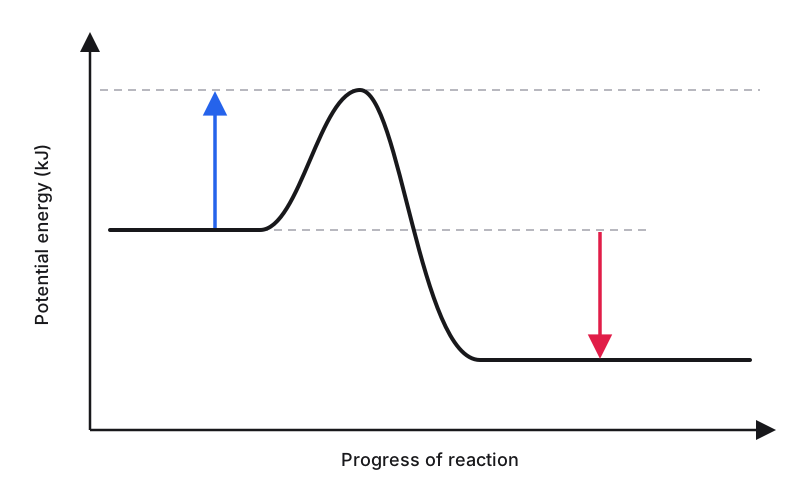
Q Slide self-check: is the graph showing the breaking of bonds or the formation of bonds?
Overall, formation. The products end up lower than the reactants, so energy was released: the reaction is exothermic, which means more energy came out of forming new bonds than went into breaking the old ones. Inside the curve you can see both steps: the climb up to the transition state (Eₐ) is energy going in to start breaking bonds, and the long drop down to the products is energy coming out as new bonds form.
Bond energy check
0 of 4 answered
- 01
Breaking the H–H bond in H₂ requires 436 kJ/mol. What happens when 1 mol of H–H bonds forms?
- 02
A reaction absorbs 900 kJ breaking bonds and releases 1,100 kJ forming bonds. The reaction is
- 03
Which bond needs the most energy to break?
- 04
Bond breaking is always
9. VSEPR: predicting the shape
Target #12. Lewis structures are flat, but molecules are 3D. VSEPR (Valence Shell Electron Pair Repulsion) says: the electron groups around a central atom repel each other and spread as far apart as possible. Count them, and the shape follows.
How to count electron domains on the central atom: every bonded atom counts as 1 (a single, double, or triple bond is still one domain), and every lone pair counts as 1.
| Domains | Lone pairs | Shape | Angle | Examples | Sketch |
|---|---|---|---|---|---|
| 2 | 0 | Linear | 180° | CO₂, HCN | O=C=O |
| 3 | 0 | Trigonal planar | 120° | BCl₃, CH₂O | flat triangle |
| 4 | 0 | Tetrahedral | 109.5° | CH₄, CH₂Cl₂ | tripod + one up |
| 4 | 1 | Trigonal pyramidal | 107° | NH₃, PCl₃ | tripod, lone pair on top |
| 4 | 2 | Bent | 104.5° | H₂O, H₂S | a V |
Lone pairs take up more room than bonding pairs, so they squeeze the bonds closer together. That is why the angle shrinks from 109.5° (CH₄) to 107° (NH₃, one lone pair) to 104.5° (H₂O, two lone pairs). Spin each one.
VSEPR shapes in 3D
Drag to rotate, scroll or pinch to zoom.
Match each molecule to its shape
Build your own: add bonds and lone pairs and watch them push apart. Switch to “Real Molecules” to compare.
10. Polar molecules: add up the dipoles
Target #5. A bond dipole is drawn as an arrow with a plus-sign tail (the δ+ end) pointing toward the more electronegative atom (the δ− end). A molecule is polar only if those arrows do not cancel when you add them up in 3D.
Polar bonds, nonpolar molecule
Both arrows lean up toward O: they add
Lone pair on top makes it lopsided
No polar bonds, perfectly symmetric
Drawn as in 3D: both Cl on the same side
Linear like CO₂, but the ends differ
Use the two-question test on any molecule.
Is the molecule polar?
Click to answer. Each answer narrows the identification.
The polarity slide again, now with the real shapes:
Polar (e⁻ shared unequally around the central atom)
- H₂O: bent, 2 lone pairs. Polar ✓
- NH₃: trigonal pyramidal, 1 lone pair. Polar ✓
- CH₂Cl₂: tetrahedral but with two kinds of outer atoms. Polar ✓
Nonpolar (e⁻ shared equally around the central atom)
- CH₄: tetrahedral, four identical nonpolar bonds. Nonpolar ✓
- IF₃: careful. The slide’s drawing leaves off iodine’s two lone pairs. With them, IF₃ is T-shaped and lopsided, so by the VSEPR rules it is polar. Open IF₃ in the 3D viewer above to see it, and check with your teacher if it shows up on a test.
Test any molecule with an electric field: polar molecules turn to line up with it, nonpolar ones do not.
Molecular polarity check
0 of 4 answered
- 01
CO₂ has two polar C=O bonds. Why is the molecule nonpolar?
- 02
Which molecule is POLAR?
- 03
In a bond dipole arrow, the arrowhead points toward
- 04
Water is polar mainly because
11. Metallic bonding: the electron sea
Targets #1 and #10. In a metal, each atom releases its valence electrons. The electrons become delocalized: they belong to the whole piece of metal, not to any one atom. What is left is a rigid framework of cations immersed in a sea of electrons that acts as the cement holding the 3D network together. That electrostatic attraction between the cations and the sea is the metallic bond.
Every metal property in your slides falls out of that one picture. Try all four tabs.
Inside a metal
Conduction of electricity
Connect a battery and one end of the metal becomes + and the other −. Because the electrons are free to move, they all feel a push toward the + end. That flow of electrons is an electric current.
Conduction of heat
Electrons in the hot area gain kinetic energy and, because they are free to move, carry it quickly to other parts of the lattice, bumping into other electrons and the cations as they go.
Malleable and ductile
Metallic bonds are non-directional: the attraction between cations and the sea works in every direction. Layers can slide past each other “like ball bearings in oil” without breaking the bond. In an ionic crystal the same slide lines up like charges, which repel, so it shatters.
Lustrous and dense
The mobile electrons absorb and re-emit light, so metals shine. Metal ions pack into a lattice that is tighter than the lattices in ionic compounds, so metals are denser.
High melting points. Generally high melting points show that metallic bonding is strong. Your slide adds: melting points increase with the number of valence electrons each atom adds to the sea, because more electrons (and higher-charged cations) means a stronger attraction.
Na gives 1 electron per atom to the sea, Mg gives 2, Al gives 3. (The Mg to Al step is small; real melting points also depend on how the atoms pack.)
Alloys
An alloy mixes a metal with other elements while keeping the electron sea. There are two ways the extra atoms fit in, as your last slide shows.
Atoms of similar size swap places at random. Harder than pure copper.
Small atoms squeeze into the gaps between big ones, so layers can no longer slide easily. Much stronger than pure iron.
The 3D lattice viewer in section 5 has a Copper metal button: compare its tight packing and electron sea with salt’s checkerboard.
Metallic bonding check
0 of 4 answered
- 01
What holds a metal together?
- 02
Why can a copper wire be bent without breaking?
- 03
Which metal should have the highest melting point?
- 04
A metal conducts electricity because
12. Conductors and insulators
Target #11. In class you test which solids conduct and rank them. Here is how real materials compare. The scale is logarithmic: each tick is 10 times the one before, and the bars span 23 powers of ten.
Each dot is one material: typical room-temperature values in siemens per meter (S/m). Graphite is the famous nonmetal exception: its carbon layers have delocalized electrons. Glass and rubber vary by type; typical values shown.
- Iron
- Silver
- Graphite (pencil core)
- Aluminum
- Rubber
- Copper
- Silicon
13. Chromatography: separating a mixture
Target #7. Paper chromatography separates the substances in a mixture (like the dyes in a marker) using what you just learned about polarity: like dissolves like.
- The stationary phase is the paper, which stays put.
- The mobile phase is the solvent, which climbs the paper by capillary action.
- A substance that dissolves well in the solvent rides along and travels far. A substance more attracted to the paper lags behind. Different attractions mean the mixture spreads into separate spots.
Run the virtual strip. Try the permanent marker in both solvents.
Separate the dyes
Choose an ink and a solvent, then run the strip.
Ink sample
Solvent
Each spot is described by its Rf value (retention factor):
Rf = distance the substance moveddistance the solvent front moved
Measure both from the pencil start line. Rf has no units and is always between 0 (did not move) and 1 (moved with the solvent front).
Q Worked example: a blue dye moves 3.2 cm while the solvent moves 8.0 cm. What is its Rf?
Rf = 3.2 cm ÷ 8.0 cm = 0.40. A yellow dye on the same strip at 6.8 cm has Rf = 6.8 ÷ 8.0 = 0.85, so the yellow dye dissolves better in this solvent than the blue one does. The same dye in the same solvent always gives about the same Rf, which is how chromatography identifies substances (forensics uses this to match inks).
Chromatography check
0 of 4 answered
- 01
Why is the start line drawn in pencil, not pen?
- 02
A dye has Rf = 0.9 in water. What does that tell you?
- 03
Permanent marker ink stays on the start line in water but separates in alcohol. Its dyes are probably
- 04
The solvent level in the beaker must start
14. The bonding lab: identify the unknowns
Targets #8 and #9. From your lab slide: you will be given two or three unknown substances; use what you have learned about the properties of ionic and covalent bonds to determine what the substances are, by designing an investigation based on melting point, solubility, and conductivity.
First, know the fingerprint each bond type leaves in the data.
| Test | Ionic | Polar covalent | Nonpolar covalent | Metallic |
|---|---|---|---|---|
| Hot plate (melting) | does not melt | melts at low to medium heat | melts fast, very low | does not melt |
| Dissolves in water? | usually yes | often yes | no | no |
| Solid conducts? | no | no | no | YES |
| Water solution conducts? | YES | no | n/a (did not dissolve) | n/a |
| Hammer | shatters (brittle) | crushes | soft, smears or crumbles | bends (malleable) |
The two tests that do the most work, as a decision tree:
Now run the lab. Every time you click “New unknowns”, the samples are reshuffled behind new letters.
Virtual lab: six unknown solids
Pick a sample, run tests, then classify every sample from your data.
1 · Sample shelf
2 · Run a test on sample A
3 · Data table (fills in as you test)
| Sample | Hot plate | In water | Solid conducts? | Solution conducts? | Hammer | 4 · Your call |
|---|
Writing the lab report
Your group report must include every part on this checklist (from the lab slide).
1
Title
Specific: “Identifying Bond Types in Three Unknown Solids”.
2
Objectives
What you will determine, and how.
3
Materials
Samples, hot plate, beakers, conductivity tester, distilled water.
4
Safety
Goggles, no tasting unknowns, hot-plate caution, tester away from water spills.
5
Drawn procedure
Labeled sketches of each test, in order. Same amount of sample each time.
6
Data table
One row per sample, one column per test (like the virtual lab).
7
Conclusion
Did the lab meet your objective? Support it with evidence (cite your data). Analyze any errors. What changes would you make (or did you make) to the procedure?
Practice the conclusion (claim, evidence, reasoning)
AI-graded. Score and feedback after each submission.
PUBLIC_AI_TUTOR_URL.
Worked example
Put every target together on one molecule you have not seen yet: phosphorus trichloride, PCl₃.
The same workflow for an ionic compound is shorter, because there is no shape or polarity to find.
1 · Classify
KBr: K is a metal, Br a nonmetal. ΔEN = 2.8 − 0.8 = 2.0, above 1.8: ionic.
2 · Electrons
K (1 valence e⁻) transfers it to Br (7), giving K⁺ and Br⁻, both with full shells.
3 · Lewis
4 · Predict
Crystal lattice → high mp (real: 734 °C), brittle, soluble, conducts only when dissolved or molten.
Practice
Try each one on paper first, then open it.
Q 1. Classify each bond using ΔEN: (a) C–S (b) Li–Cl (c) P–H (d) O–F (e) Ca–O
(a) C–S: 2.5 − 2.5 = 0.0, nonpolar covalent. (b) Li–Cl: 3.0 − 1.0 = 2.0, ionic. (c) P–H: 2.2 − 2.1 = 0.1, nonpolar covalent. (d) O–F: 4.0 − 3.5 = 0.5, polar covalent (F is δ−). (e) Ca–O: 3.5 − 1.0 = 2.5, ionic.
Q 2. Which element in each pair is more likely to LOSE electrons: (a) Na or Cl (b) Mg or S (c) K or Br?
The metal every time: Na, Mg, K. They sit on the left of the table, have 1 or 2 valence electrons, and low electronegativity, so they form cations. The nonmetals (Cl, S, Br) gain electrons to become anions.
Q 3. Draw the Lewis structure of HCN.
10 valence electrons (1 + 4 + 5). C goes in the middle (H is never central). H–C uses 2 and a C≡N triple bond uses 6; the last 2 are a lone pair on N. H has 2, C has 8, N has 8.
1 single bond, 1 triple bond, 1 lone pair
Q 4. Draw the Lewis structure of formaldehyde, CH₂O.
12 valence electrons (4 + 2 + 6). C is central. With only single bonds C would have 6, so one O lone pair becomes a second bond: C=O, plus two C–H bonds and two lone pairs on O.
Trigonal planar around C; polar (the C=O dipole is not canceled)
Q 5. Draw OF₂ and predict its shape and polarity.
20 valence electrons (6 + 2 × 7). O is central with 2 bonds and 2 lone pairs: 4 domains, so bent (like water). O–F is polar (ΔEN 0.5) and the bent shape keeps the dipoles from canceling, so OF₂ is polar.
Bent, polar
Q 6. CCl₄ has four polar C–Cl bonds. Is the molecule polar?
No. Carbon has 4 domains and no lone pairs, so CCl₄ is a perfect tetrahedron with four identical outer atoms. The four equal dipoles cancel in 3D, so the molecule is nonpolar, even though every bond is polar.
Q 7. Use bond energies to find ΔH for N₂ + 3 H₂ → 2 NH₃ (N≡N 945, H–H 436, N–H 391 kJ/mol).
Break: 1 N≡N + 3 H–H = 945 + 3(436) = 2,253 kJ in. Form: 2 NH₃ have 6 N–H bonds = 6(391) = 2,346 kJ out. ΔH = 2,253 − 2,346 = −93 kJ: exothermic.
Q 8. A red dye travels 4.5 cm while the solvent front travels 7.5 cm. What is the Rf? Is the dye more attracted to the solvent or the paper?
Rf = 4.5 ÷ 7.5 = 0.60. It moved more than halfway with the solvent, so it is somewhat more attracted to the solvent than to the paper. A dye with Rf 0.2 on the same strip would cling to the paper more.
Q 9. Lab data: Sample Q melts on the hot plate within seconds, does not dissolve in water, and does not conduct. Sample R does not melt, does not dissolve, conducts as a solid, and flattens under a hammer. Identify both.
Q: nonpolar covalent (very low melting point and insoluble in polar water: wax-like). R: metallic (conducts as a solid and is malleable: electron sea).
Q 10. Explain, using the electron sea, why aluminum foil can be folded but a salt crystal shatters.
In aluminum the cations sit in a sea of delocalized electrons that attracts them in every direction, so layers slide over each other and stay bonded. In a salt crystal, sliding a layer lines up + next to + and − next to −; those like charges repel and the crystal splits apart.
Quiz
Bonding unit test prep
0 of 12 answered
- 01
Which pair of elements forms an ionic bond?
- 02
In a nonpolar covalent bond, the electrons are
- 03
Mg has EN 1.2 and O has EN 3.5. The Mg–O bond has
- 04
How many valence electrons are in one molecule of HCN?
- 05
Compared with a C–C single bond, a C≡C triple bond is
- 06
Which statement about breaking a chemical bond is correct?
- 07
What is the shape of NH₃?
- 08
Which molecule is nonpolar?
- 09
Metals conduct heat well because
- 10
An unknown solid conducts electricity as a solid and bends instead of breaking. It is most likely
- 11
A dye moves 2.0 cm and the solvent front moves 8.0 cm. The dye's Rf is
- 12
Salt water conducts electricity but sugar water does not, because
Flashcards
Flashcards
1 / 31 · browse mode
Ratings schedule next review · view all due cards
Mnemonics
BARF
Breaking Absorbs, Releasing Forms. Breaking bonds takes energy in; forming bonds gives energy out.
FONClBrISCH
Say “fon-cul-brisch.” Electronegativity from strongest to weakest: F 4.0, O 3.5, N and Cl 3.0, Br 2.8, I, S, C 2.5, H 2.1.
HONC 1-2-3-4
How many bonds each atom usually makes: H 1, O 2, N 3, C 4. A quick check on any Lewis structure.
”Point four for a tie, one-eight to say goodbye”
ΔEN up to 0.4: the tug-of-war is a tie (nonpolar). Above 1.8: the electron says goodbye and leaves (ionic). In between: polar.
Lone pairs are bullies
They take up more room and push the bonds closer: 109.5° (CH₄) → 107° (NH₃) → 104.5° (H₂O).
Metals lose, nonmetals choose
Metals give electrons away. Nonmetals choose: take them from a metal (ionic) or share with another nonmetal (covalent).
Like dissolves like
Polar with polar, nonpolar with nonpolar. It explains salt and sugar in water, wax in oil, and every chromatography strip.
Rf = spot over front
Distance to the spot on top, distance to the solvent front on the bottom. The answer can never be bigger than 1.
Common pitfalls
The covalent bond itself is strong (C–C needs 347 kJ/mol, N≡N 945). What is weak are the attractions between separate molecules. When water boils, no O–H bonds break; the molecules just pull away from each other. That is what the slide’s “weak bonds (comparatively)” and “low boiling points” are really about.
Ionic compounds form a lattice, not molecules. “NaCl” only says there is one Na⁺ for every Cl⁻. (Some diagrams label the product “ionic molecule”; on a test, say ionic compound or formula unit.)
Only if the dipoles do not cancel. CO₂, BCl₃, and CCl₄ all have polar bonds and are nonpolar because their shapes are symmetric. Always check the shape.
The slide’s IF₃ drawing leaves out iodine’s two lone pairs. Iodine has 5 electron domains (3 bonds + 2 lone pairs), so the molecule is T-shaped and lopsided: by the VSEPR rules it is polar. If it comes up on a test, ask your teacher which answer they want; the chemistry says polar. (This is also an octet exception: iodine holds 10 electrons.)
Bond order only predicts length when the same two elements are bonded: C–C (154 pm) is longer than C=C (134 pm). Across different elements, atom size matters too: the C–H bonds in CH₄ are actually only 109 pm, shorter than the C=C in C₂H₄, because hydrogen is tiny. Your slide’s self-check ranks by bond order (CH₄ > C₂H₄ > N₂), which is the reasoning your class is testing.
Most do, but not all. Mercury melts at −39 °C (it is a liquid), gallium at 30 °C (it melts in your hand), and sodium at 98 °C. Say “metals usually have high melting points.”
“Occurs between metals” means between metal atoms. A pure copper wire, with only one element, is held together by metallic bonding. Alloys (brass, steel) are just one kind of metallic solid.
Solid ionic compounds do not conduct: their ions are locked in the lattice. They conduct only when dissolved or molten. And dissolving alone is not proof of ionic: sugar dissolves but never conducts.
Breaking a bond always absorbs energy. When a reaction gives off energy, it is because the new bonds that form release more than the old ones cost to break.
A double or triple bond is one domain (it points in one direction). CO₂ has 2 domains on carbon, not 4, which is why it is linear and not tetrahedral.
Cheat sheet
- e⁻ transferred
- metal + nonmetal
- ΔEN above 1.8
- lattice, high mp, brittle
- conducts dissolved or molten
- e⁻ shared unequally
- different nonmetals
- ΔEN 0.4 to 1.8
- δ+ and δ−; often dissolves
- never conducts
- e⁻ shared equally
- identical or similar nonmetals
- ΔEN 0.4 or less
- low mp; does not dissolve in water
- never conducts
- e⁻ pooled in a sea
- metal atoms
- usually high mp
- malleable, ductile, lustrous
- conducts as a solid
Lewis structure in 6 steps
- Count all valence e⁻
- Skeleton: H outside, least EN in the center
- Single bonds (2 e⁻ each)
- Lone pairs: outer atoms, then center
- Check: 8 each, 2 for H
- Short? Make double or triple bonds
VSEPR shapes
- 2, 0 LP: linear 180° (CO₂)
- 3, 0 LP: trigonal planar 120° (BCl₃)
- 4, 0 LP: tetrahedral 109.5° (CH₄)
- 4, 1 LP: trigonal pyramidal 107° (NH₃)
- 4, 2 LP: bent 104.5° (H₂O)
Equations and rules
- ΔEN = larger EN − smaller EN
- ΔH = bonds broken − bonds formed
- Rf = spot distance ÷ solvent front distance
- More shared pairs → shorter, stronger
- Polar molecule = polar bonds + dipoles do not cancel
Q Table view: the melting-point chart from section 1
Ionic: MgO 2852 °C · CaF₂ 1418 · NaF 993 · LiF 845 · NaCl 801 · CaCl₂ 772 · KCl 770. Metallic: W 3422 · Fe 1538 · Cu 1085 · Au 1064 · Al 660 · Na 98 · Hg −39. Polar covalent: sucrose 186 (breaks down) · glucose 146 · water 0 · ammonia −78 · HCl −114 · ethanol −114. Nonpolar covalent: I₂ 114 · naphthalene 80 · paraffin wax about 60 · CO₂ sublimes at −78 · CH₄ −182 · N₂ −210 · O₂ −218.
Bonding cold-recall sheet
Say each line from memory