
APUSH Unit 3: Revolution and the New Republic
A heavily visual deep-dive on Period 3 (1754-1800): the French and Indian War, Britain's new taxes and the colonial resistance, Enlightenment ideas, the Revolution, the Articles of Confederation, the Constitution and Bill of Rights, Washington and Hamilton, the first political parties, and the Election of 1800.
Spinning up the 3D globe, simulations, scrollytelling, and 60+ widgets. We'll bring you back to where you left off when this finishes.
APUSH Unit 3 · Period 3
Revolution and the New Republic
1754 to 1800
The unit on one page
Three chapters, thirteen College Board topics. Keep this map in your head the whole way through.
AMSCO Chapter 4 · 1754-1774
Imperial Wars and Colonial Protest
- 3.1 Contextualizing Period 3
- 3.2 The Seven Years’ War (French and Indian War)
- 3.3 Taxation Without Representation
- 3.4 Philosophical Foundations of the Revolution
AMSCO Chapter 5 · 1774-1787
The American Revolution and Confederation
- 3.5 The American Revolution
- 3.6 The Influence of Revolutionary Ideals
- 3.7 The Articles of Confederation
AMSCO Chapter 6 · 1787-1800
The Constitution and the New Republic
- 3.8 The Constitutional Convention and Ratification
- 3.9 The Constitution
- 3.10 Shaping a New Republic
- 3.11 Developing an American Identity
- 3.12 Movement in the Early Republic
- 3.13 Continuity and Change in Period 3
The whole unit in one chain
Memorize this storyline before anything else. Every link causes the next one, and almost every essay prompt in this unit is really asking you to explain one of these arrows. The border style tells you which chapter each link lives in.
- 1French and Indian War
- 2British war debt
- 3New taxes, tighter control
- 4Colonial resistance
- 5Enlightenment arguments
- 6Declaration of Independence
- 7Revolutionary War
- 8Articles of Confederation
- 9A national government too weak
- 10Constitutional Convention
- 11Constitution + Bill of Rights
- 12Washington and Hamilton
- 13First political parties
- 14Adams, Alien and Sedition Acts
- 15Election of 1800
Master timeline, 1754 to 1801
Two halves, one story. Drag sideways to move through time and scroll or pinch to zoom. In the first half, watch the “Britain acts” and “Colonists respond” lanes answer each other like a conversation that keeps getting louder; in the second, watch the new nation build (and rebuild) its government while the wars wind down.
Part 1: from empire to independence, 1754 to 1776
Part 2: winning the war and building a nation, 1776 to 1801
Learning objectives
By the end of this guide you will be able to:
- Explain how the Seven Years’ War (French and Indian War) changed the relationship between Britain and its colonies, and why it ended salutary neglect.
- Trace the escalation from 1763 to 1774: every major British act, what it did, and exactly how colonists resisted it.
- Explain how Enlightenment ideas (Locke’s natural rights, the social contract, republicanism) and Common Sense turned tax protests into a movement for independence.
- Narrate the Revolutionary War from Lexington to Yorktown, explain why the Americans won, and state the terms of the Treaty of Paris (1783).
- Evaluate how revolutionary ideals changed life (and failed to change it) for women, enslaved and free African Americans, and Native Americans.
- Describe the Articles of Confederation: its structure, real accomplishments (the Land and Northwest Ordinances), and the weaknesses exposed by Shays’ Rebellion.
- Explain the compromises of the Constitutional Convention, the principles of the Constitution, the ratification fight, and why the Bill of Rights exists.
- Analyze Washington’s and Adams’s presidencies: Hamilton’s financial plan, the first political parties, neutrality, the Whiskey Rebellion, the Alien and Sedition Acts, and the Election of 1800.
- Build continuity and change arguments for the whole period: the Revolution transformed politics far more than it transformed society.
TL;DR
Britain won the Seven Years’ War (1754-1763) and took France’s North American empire in the Treaty of Paris (1763), but its debt nearly doubled, so it ended salutary neglect and made the colonists pay: the Proclamation of 1763 (after Pontiac’s Rebellion), the Sugar Act, Quartering Act, and the Stamp Act (the first direct tax). Colonists answered with the Stamp Act Congress, the Sons and Daughters of Liberty, and boycotts, won a repeal, and then got the Declaratory Act (Parliament can legislate “in all cases whatsoever”). The Townshend Acts brought Dickinson’s Letters, the Circular Letter, and more boycotts; the Boston Massacre (1770) and Tea Party (1773) led to the Coercive (Intolerable) Acts (1774), which united the colonies instead of isolating Massachusetts. Enlightenment ideas (Locke: natural rights, consent, the right of revolution) and Paine’s Common Sense turned protest into independence (July 4, 1776). After early losses, Saratoga (1777) won the French alliance, and Yorktown (1781) won the war; the Treaty of Paris (1783) set the border at the Mississippi. The Articles of Confederation won the war and passed the Northwest Ordinance but could not tax or regulate trade, and Shays’ Rebellion (1786-87) proved it. The Constitution (1787) fixed that through compromises (Great, Three-Fifths, Commerce) and federalism, separation of powers, and checks and balances; Federalists beat Anti-Federalists by promising the Bill of Rights (1791). Washington set precedents, Hamilton’s financial plan split the nation into the first political parties (Federalists vs Democratic-Republicans), and foreign wars tested neutrality. Adams survived the XYZ Affair but passed the Alien and Sedition Acts, provoking the Kentucky and Virginia Resolutions, and the Election of 1800 handed power peacefully to Jefferson: the “Revolution of 1800.”
Glossary
Every one of these can appear on your test. Hover each card now, then drill the flashcards at the end until they are automatic.
Seven Years' War / French and Indian War (1754-1763) Albany Plan of Union (1754) Treaty of Paris (1763) Salutary neglect Pontiac's Rebellion (1763) Proclamation of 1763 Direct vs indirect tax Virtual representation Stamp Act Congress (1765) Sons and Daughters of Liberty Declaratory Act (1766) Townshend Acts (1767) Writs of assistance Committees of Correspondence (1772) Coercive (Intolerable) Acts (1774) Natural rights and the social contract Republicanism Common Sense (1776) Olive Branch Petition (1775) Loyalists (Tories) Battle of Saratoga (1777) Republican Motherhood Articles of Confederation (1781-1789) Northwest Ordinance (1787) Shays' Rebellion (1786-1787) Great (Connecticut) Compromise Three-Fifths Compromise Federalists vs Anti-Federalists Bill of Rights (1791) Hamilton's financial plan Loose vs strict construction Whiskey Rebellion (1794) Jay's Treaty and Pinckney's Treaty (1794-1795) XYZ Affair (1797-1798) Alien and Sedition Acts (1798) Kentucky and Virginia Resolutions (1798) Revolution of 1800Section 1 · The War That Won an Empire
AMSCO Ch. 4 · Topics 3.1 + 3.2
The Seven Years’ War
The last of four wars between Britain and France for North America. Britain won nearly everything, then discovered what winning cost.
1.1 Where Period 2 left us
For a century Britain ran its colonies with a light hand (salutary neglect). Colonists got used to elected assemblies that taxed them, paid their governors’ salaries, and ignored trade laws when convenient. Meanwhile Britain and France fought over land and trade, and Native nations played the two empires against each other to protect their own land. The period from 1754 to 1800 is defined by three big developments:
1.2 Four wars, one rivalry
The French and Indian War was not a one-off. It was the fourth round of a fight that ran from 1689 to 1763. The first three were fought mostly in Europe; the fourth started in the American woods and decided the continent.
Round 1 · 1689-1697
King William’s War
British try to take Quebec and fail. French-allied raids burn frontier towns.
Round 2 · 1702-1713
Queen Anne’s War
Britain wins Nova Scotia and trading rights in Spanish America.
Round 3 · 1744-1748
King George’s War
New Englanders capture the fortress of Louisbourg; Britain hands it back in the peace deal. New England is furious.
Round 4 · 1754-1763
Seven Years’ War
Starts in the Ohio Valley. Both empires ship regular armies to America. Winner takes the continent.
1.3 The map before the war
This is North America around 1750. Click each marker. Notice the shape of the problem: a thin strip of British colonies (red) with over a million people, boxed in by a huge arc of French claims (blue) held by only about 70,000 colonists, plus their Native allies.

1.4 How the war unfolded
Click through the war in six moves. The pattern to notice: British disasters while they leaned on colonial militias, British victory once London poured in its own money and regulars.
1.5 Join, or Die
Franklin printed this cartoon in his Pennsylvania Gazette on May 9, 1754, to sell the Albany Plan. It is one of the most tested images in all of APUSH. Click each piece of the snake.

1.6 Who won what: the map after 1763
The same continent after the peace. Study the legend for a moment, then test yourself: the quiz names a region, and you click the dot that marks it.
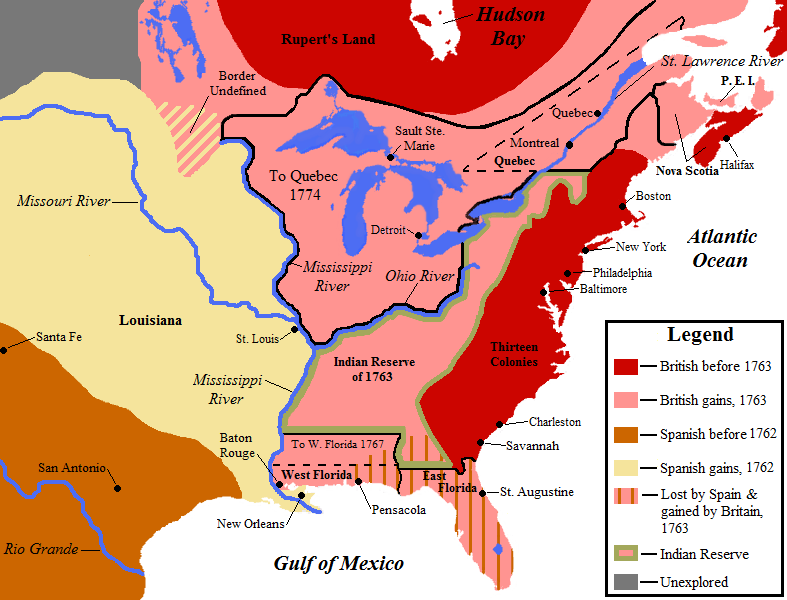
1.7 The bill, and two opposite lessons
The war also taught Britain and the colonists opposite lessons about each other. Compare the two views, then read what real participants said.
🇬🇧 The British view
- Colonial militias were a poorly trained, disorderly rabble
- Some colonies refused to send troops or money at all
- The colonists were unable and unwilling to defend the new frontier themselves
- So Britain must keep an army in America, and the colonists must help pay for it
🏹 The colonial view
- Colonists were proud of their record in all four wars
- They felt confident they could defend themselves
- They were unimpressed by British officers, whose European tactics failed in American forests
- So why pay for an army they did not think they needed?
The Americans are in general the dirtiest, most contemptible, cowardly dogs that you can conceive.
He had too much self-confidence, too high an opinion of the validity of regular troops, and too mean a one of both Americans and Indians.
Section 1 self-quiz
The Seven Years' War
0 of 6 answered
- 01
The French and Indian War began mainly over control of
- 02
The Albany Plan of Union (1754) failed primarily because
- 03
The British victory in the Seven Years' War was secured mainly by
- 04
Under the Treaty of Paris of 1763,
- 05
Which statement best describes the BRITISH view of the colonists after the war?
- 06
The most important long-term effect of the French and Indian War on the colonies was that it
Section 2 · The Empire Tightens Its Grip
AMSCO Ch. 4 · Topics 3.2 + 3.3
Taxation Without Representation
From London, every act was a reasonable way to pay for the empire. From Boston, every act was proof of a plot against liberty. Both sides kept escalating for eleven years.
2.1 Salutary neglect ends
Before 1763
A light hand
- Navigation Acts on the books, rarely enforced
- Smuggling tolerated as a way of life
- Colonial assemblies vote the taxes and pay the governors
- Few British soldiers in the colonies
After 1763
A heavy hand
- Trade laws enforced; smugglers tried in admiralty courts without juries
- Parliament taxes the colonies directly to raise revenue
- A standing army of about 10,000 stays in America
- Royal officials paid by the crown, not by the assemblies
2.2 The frontier explodes
The first test of the new policy came from the west, not from Boston. Native nations in the Ohio Valley watched settlers pour onto their land, and the British, unlike the French, refused to keep up the diplomatic gift-giving that had held alliances together.
1763 · The uprising
Pontiac’s Rebellion
The Ottawa chief Pontiac led an alliance that destroyed British forts and settlements from New York to Virginia. Britain crushed it with regular British troops, not colonial militia: exactly the “we must defend the colonies ourselves” logic of the new policy.
1763 · The response
The Proclamation of 1763
To stop more frontier wars, Britain banned settlement west of the Appalachians. Colonists who had fought for that land felt robbed of the prize. Thousands crossed the line anyway, and the British could not stop them. The first British act to anger the colonists.
2.3 Two arguments behind every fight
Before the acts, learn the two ideas the colonists and Parliament argued about. Every act in the ladder below is a new round of these two debates.
Argument 1 · Who pays?
Indirect (external) tax
A duty on imports, paid by the merchant at the dock and hidden in the price. Sugar Act, Townshend Acts.
Direct (internal) tax
Paid by ordinary people on things they use every day: newspapers, wills, licenses. The Stamp Act, the first ever.
Argument 2 · Who represents you?
Virtual representation
Parliament: every member speaks for every British subject. Manchester elects no one and is still “represented.” So are you.
Actual representation
Colonists: only representatives we elect can tax us. That means our assemblies, never Parliament. “No taxation without representation.”
2.4 The escalation ladder, 1763 to 1774
Scroll the ladder. Each rung is one British action (the card title) and what it did (subtitle); open the card to see how colonists answered. Notice how each answer provokes the next act.
2.5 Did the boycotts actually work?
Yes, and you can see it in the trade data. The line below is the value of English goods shipped to the thirteen colonies each year. Every dip is a boycott; every repeal follows a dip.
English exports to the thirteen colonies, 1763 to 1775 (£ millions per year, rounded; Historical Statistics of the United States)
2.6 The Boston Massacre, as propaganda
Paul Revere’s famous engraving of March 5, 1770 is a primary source about the event and, more importantly, about how Patriots sold it. Zoom in and click each red marker to see what Revere chose to show.
2.7 From tea to the Intolerable Acts
The most important chain in Chapter 4. Watch it play out.
Tea Party to Intolerable Acts, 1773 to 1774
2.8 The Intolerable Acts, one card each
Port Act
Closed Boston harbor until the destroyed tea was paid for.
Massachusetts Government Act
Cut the legislature’s power; boosted the royal governor’s.
Administration of Justice Act
Royal officials accused of crimes could be tried in Britain, not by colonial juries.
Quartering Act (expanded)
Troops could be quartered in private buildings. Applied to every colony.
Quebec Act (separate)
Catholicism official in Quebec, no elected assembly, borders pushed to the Ohio River.
2.9 Which act is it?
Stimulus questions describe an act without naming it. Answer yes or no and let the key name the law.
Identify the British act from what it did
Click to answer. Each answer narrows the identification.
Section 2 self-quiz
Taxation without representation
0 of 8 answered
- 01
The Proclamation of 1763 angered colonists mainly because it
- 02
The Stamp Act (1765) provoked more opposition than earlier acts because it was
- 03
The Stamp Act Congress (1765) is significant because delegates from nine colonies
- 04
Parliament passed the Declaratory Act (1766) in order to
- 05
John Dickinson's Letters from a Farmer in Pennsylvania argued that
- 06
The Committees of Correspondence were important because they
- 07
Colonists objected to the Tea Act of 1773 even though it lowered the price of tea because
- 08
The most important result of the Coercive (Intolerable) Acts was that they
Section 3 · Ideas That Made a Revolution
AMSCO Ch. 4 · Topic 3.4
Philosophical Foundations
The Revolution was not only about taxes. By 1776 colonists were asking a bigger question: what gives any government the right to rule at all?
3.1 The Enlightenment toolkit
The Enlightenment peaked in the mid-1700s, exactly when Washington, Jefferson, Franklin, and Adams were growing up. Many of them were Deists, who believed God created a universe run by natural laws that human reason could discover. Apply that thinking to government and you get the six tools below.
Natural rights
People are born with rights to life, liberty, and property. No king grants them, so no king can take them. (John Locke)
Social contract
People agree to create a government for one purpose: to protect those rights. Developed further by Jean-Jacques Rousseau.
Consent of the governed
A government’s only legitimate power comes from the people it governs. Later called popular sovereignty.
Right of revolution
A government that breaks the contract by violating rights can be altered or overthrown. The logic of 1776.
Republicanism
Rule by elected representatives, kept honest by citizens’ civic virtue, and hostile to kings, aristocrats, and concentrated power.
Reason over tradition
Rationalism: trust human reason and science to solve problems, instead of accepting authority because it is old or royal.
3.2 From Locke to Jefferson
Put Locke’s ideas next to the Declaration’s words and you can see the translation. Jefferson did not invent the theory; he turned it into a public argument.
3.3 Common Sense: the pamphlet that tipped the colonies
In January 1776, most colonists still wanted to fix their relationship with Britain, not end it. Then Thomas Paine, a recent English immigrant, published Common Sense. Instead of complaining about Parliament’s taxes, he attacked monarchy itself and argued for immediate independence, in language any farmer could follow.
There is something very absurd, in supposing a continent to be perpetually governed by an island.
O ye that love mankind! Ye that dare oppose, not only the tyranny, but the tyrant, stand forth!
It is spring 1776 and you are undecided. Which argument would move you most?
3.4 Read the Declaration like a grader
The Declaration has three parts: a theory of government (the famous opening), a long list of grievances against George III, and the formal declaration that the colonies are free and independent states. The exam quotes the first part constantly. Hover each highlight.
We hold these truths to be self-evident, that all men are created equal, that they are endowed by their Creator with certain unalienable Rights, that among these are Life, Liberty and the pursuit of Happiness. That to secure these rights, Governments are instituted among Men, deriving their just powers from the consent of the governed, That whenever any Form of Government becomes destructive of these ends, it is the Right of the People to alter or to abolish it, and to institute new Government, laying its foundation on such principles and organizing its powers in such form, as to them shall seem most likely to effect their Safety and Happiness.
Section 3 self-quiz
Ideas and independence
0 of 5 answered
- 01
John Locke's theory of the social contract holds that governments
- 02
Thomas Paine's Common Sense was influential mainly because it
- 03
Jefferson's phrase 'the pursuit of Happiness' adapted which of Locke's natural rights?
- 04
Which idea from the Declaration of Independence most directly justified breaking away from Britain?
- 05
Republicanism, as colonists understood it, emphasized
Section 4 · From Protest to War to Victory
AMSCO Ch. 5 · Topic 3.5
The American Revolution
In 1774 almost nobody wanted independence. They wanted things back the way they were before the French and Indian War. Two years later they declared a new nation.
4.1 The First Continental Congress, 1774
The Intolerable Acts drove every colony except Georgia to send delegates to Philadelphia in September 1774. Their goal was to resist the acts and restore their rights, not to leave the empire. The delegates spanned the whole political spectrum:
Radicals
Patrick Henry, Samuel Adams, John Adams
Demand the biggest concessions from Britain
Moderates
George Washington, John Dickinson
Firm resistance, but hoping for a settlement
Conservatives
John Jay, Joseph Galloway
A mild protest; Galloway’s union plan failed by one vote
4.2 The road to July 4, 1776
Eight moves from the first shots to independence. Notice how long the colonists kept trying for peace even after the fighting started.
4.3 Choosing sides
About 2.6 million people lived in the thirteen colonies. The Revolution was also a civil war: neighbors, even families, fought each other (Benjamin Franklin’s son William was the last royal governor of New Jersey and a Loyalist). Each square below is 1 percent of the population.
AMSCO’s estimates, out of about 2.6 million people.
Patriots (~40%)
Strongest in New England and Virginia. Most served in local militias for short stints, then went home to farm, so Washington never commanded more than about 20,000 regulars at once, chronically short of supplies and pay.
Loyalists, or Tories (20 to 30%)
Probably a majority in New York, New Jersey, and Georgia. Often wealthier and more conservative, including most royal officials and Anglican clergy. About 60,000 fought for Britain; about 80,000 left for Canada or Britain after the war.
African Americans
When the British promised freedom to enslaved people who joined them (Virginia’s royal governor, Lord Dunmore, in 1775), Washington and Congress soon made the same offer. About 5,000 African Americans fought as Patriots, mostly free men from the North; thousands of enslaved people escaped to British lines.
Native Americans
At first most tried to stay out. Colonial attacks pushed many to side with Britain, which had promised (with the Proclamation of 1763) to limit settlement in the West. An American victory meant more settlers on their land.
4.4 The war on the map
The war had two acts. From 1775 to 1778 the fighting stayed in the North; after 1778 Britain switched to a southern strategy, betting on the South’s many Loyalists. Red dots are American (or French) wins, black dots are British wins. Click any dot for the story.
4.5 Saratoga to Yorktown
The single most important causal chain of the war. Your notes put it simply: the French alliance saved the Patriots.
How the war was won, 1777 to 1781
4.6 Why did the underdog win?
A favorite causation question. Britain had the bigger army, the best navy, and far more money. It lost anyway.
American advantages
- ⭐ Washington’s leadership: he kept an army in existence, which was enough
- 🗺️ Home ground: familiar land and huge territory to retreat into
- 🔥 Motivation: fighting for their own homes and ideals
- ♻️ Resilience: they could lose battles (and did) and keep fighting
- ⚜️ Foreign help: the French alliance, above all the French navy
British problems
- 🚢 Distance: 3,000 miles of ocean between London and the army
- 📦 Long supply lines for every musket ball and biscuit
- 🌲 Too much land: they could take cities but never control the countryside
- 🌍 A world war after 1778: France, Spain, and the Dutch to fight too
- 💷 Political cost: the war grew unpopular and expensive at home
4.7 The Treaty of Paris, 1783
Section 4 self-quiz
The Revolution
0 of 7 answered
- 01
Most delegates to the First Continental Congress (1774) wanted to
- 02
The Olive Branch Petition (1775) is significant because it
- 03
The Battle of Bunker Hill (1775) resulted in
- 04
Which group was MOST likely to be Loyalist during the Revolution?
- 05
The Battle of Saratoga (1777) was the turning point of the war mainly because it
- 06
The French contribution was decisive at Yorktown mainly because
- 07
Under the Treaty of Paris of 1783, the United States
Section 5 · Revolutionary Ideals, Unevenly Applied
AMSCO Ch. 5 · Topic 3.6
Who Did Liberty Include?
The Revolution changed American society, but not equally. The distinction between change and continuity is the whole point of this topic.
5.1 New state governments
While the war raged, the former colonies wrote constitutions; ten had done it by 1777. Conservatives wanted law and order, liberals wanted protection against tyranny, and almost every state ended up with the same four features:
5.2 Who gained what?
Each card shows what changed (red) and what stayed the same (black). Essays reward you for naming both.
👩 Women
Changed
Ran farms and businesses while men fought; powered the boycotts (Daughters of Liberty); served as nurses and cooks; a few fought, like Mary McCauley (“Molly Pitcher”) at Monmouth and Deborah Sampson, disguised as a man. Republican Motherhood made women’s education matter.
Stayed the same
Still second-class: no vote (New Jersey’s brief exception ended in 1807), and married women still could not own property in their own names.
✊🏾 African Americans
Changed
About 5,000 fought as Patriots; thousands won freedom behind British lines. Northern states began ending slavery, Congress stopped the importation of enslaved people during the war, and some southern owners freed the people they enslaved.
Stayed the same
Slavery survived and grew in the South, where owners built new justifications for it. Free Black Americans still faced discrimination everywhere.
🪶 Native Americans
Changed
For the worse: Britain’s defeat removed the one power that had tried to limit settlement, and the 1783 treaty handed their lands to the U.S. without consulting them.
Stayed the same
Constant pressure on their land from settlers, now backed by a new nation hungry for the West.
⛪ Religion
Changed
Most states separated church and state; the Anglican Church lost its tax support in the South. Jefferson’s Virginia Statute for Religious Freedom (1786) became the model.
Stayed the same
New Hampshire, Connecticut, and Massachusetts kept taxes supporting the Congregational Church for decades (Massachusetts until 1833).
🎩 Aristocracy
Changed
Titles of nobility banned; primogeniture (the eldest son inherits everything) abolished; big Loyalist estates confiscated, split up, and sold.
Stayed the same
Wealthy elites still dominated politics, and great economic inequality remained.
🧑🌾 Ordinary white men
Changed
Written constitutions with bills of rights, more elected offices, and a republican culture that valued the common citizen.
Stayed the same
Voting still required property, and holding office required even more.
5.3 “Remember the Ladies”
In March 1776, while John Adams sat in the Continental Congress, his wife Abigail wrote to him from Massachusetts. Read the exchange; it is a favorite stimulus.
I desire you would Remember the Ladies, and be more generous and favourable to them than your ancestors. Do not put such unlimited power into the hands of the Husbands.
Depend upon it, We know better than to repeal our Masculine systems.
5.4 Slavery’s first retreats, and its limits
The Revolution’s language of liberty pushed several northern states to end slavery, almost always gradually (children born after a certain date would be freed as adults). Plot the dates, then notice what is missing: no southern state appears.
5.5 A revolution heard around the world
The American Revolution proved that Enlightenment ideas could overthrow an empire, and the world noticed.
Section 5 self-quiz
Revolutionary ideals
0 of 5 answered
- 01
Most new state constitutions written during the Revolution
- 02
The idea of 'Republican Motherhood' held that women
- 03
Abigail Adams's request that her husband 'Remember the Ladies' is best used as evidence of
- 04
Which statement best describes slavery in the decades right after the Revolution?
- 05
For most Native Americans, the outcome of the Revolution meant
Section 6 · The Articles of Confederation
AMSCO Ch. 5 · Topic 3.7
Weak on Purpose
Americans had just fought a war against a powerful central government. So their first national government was designed to be too weak to become a tyranny. It worked, a little too well.
6.1 The structure
John Dickinson drafted the Articles in 1776; Congress adopted them in 1777, but they were not ratified until 1781 because Maryland refused to sign until states like Virginia and New York gave up their claims to western land. Here is the whole national government:
The only branch
Congress
One house (unicameral) · one vote per state · 9 of 13 states to pass important laws · all 13 to amend
Missing
No president
Nobody to enforce the laws Congress passed
Missing
No national courts
No system to settle disputes or interpret national law
The real power: thirteen states that kept their own taxes, trade rules, currencies, and militias. The Articles called their union “a firm league of friendship.”
6.2 What Congress could and could not do
✅ Could
- ✅ Wage war
- ✅ Make treaties
- ✅ Send diplomats
- ✅ Borrow money
❌ Could not
- ❌ Collect taxes (it could only ask the states for money)
- ❌ Regulate commerce, between states or with other nations
- ❌ Enforce its laws (no executive) or force states to comply
- ❌ Amend itself without all thirteen states agreeing
6.3 Real accomplishments
Do not write “the Articles accomplished nothing.” That is an easy way to lose a point. The Articles government won the war, negotiated the Treaty of Paris, and passed two laws that shaped the whole West.
The Land Ordinance of 1785
Congress had millions of acres of western land and no taxing power, so it decided to survey the land in a grid and sell it. Watch the surveyors’ lines draw a township: 6 miles on each side, divided into 36 one-square-mile sections of 640 acres each. The law reserved section 16 of every township for public schools.
The Northwest Ordinance of 1787
The Articles’ greatest achievement. It turned the territory between the Ohio River and the Great Lakes into a ladder to statehood that every later territory would climb.
Step 1
Territory
Congress appoints a governor, a secretary, and three judges.
Step 2 · 5,000 free adult men
Self-government
Settlers elect their own territorial legislature and send a nonvoting delegate to Congress.
Step 3 · 60,000 people
Statehood
Write a constitution and join the Union on an equal footing with the original states.
6.4 Three kinds of trouble
💸 Financial
War debts went unpaid because Congress could only request money, and states rarely sent it. Congress and the states printed nearly worthless paper money. Credit dried up and a depression followed.
🌍 Foreign
European nations had little respect for a country that could not pay its debts. Britain kept its forts on the western frontier and restricted American trade; Spain threatened American access to the Mississippi.
🏠 Domestic
States taxed each other’s goods with tariffs and fought over boundaries. And in 1786, farmers in western Massachusetts took up arms against their own state.
6.5 Shays’ Rebellion: you are the Confederation Congress
Play the crisis that ended the Articles, then read what actually happened.
New York City, autumn 1786
You are a member of the Confederation Congress. In western Massachusetts, Daniel Shays, a Revolutionary War veteran, leads hundreds of farmers who are drowning in debt and high state taxes and furious that debtors are being thrown in jail. They have shut down the courts that foreclose on farms. Nearby sits the federal arsenal at Springfield, full of muskets. Massachusetts is asking for help.
I am mortified beyond expression when I view the clouds that have spread over the brightest morn that ever dawned upon any country.
I hold it that a little rebellion now and then is a good thing, and as necessary in the political world as storms in the physical.
Section 6 self-quiz
The Articles of Confederation
0 of 6 answered
- 01
The Articles of Confederation created a national government that
- 02
Ratification of the Articles was delayed until 1781 mainly by a dispute over
- 03
Which was the greatest weakness of the government under the Articles?
- 04
The Northwest Ordinance of 1787 is significant because it
- 05
The Land Ordinance of 1785 provided for
- 06
Shays' Rebellion convinced many American leaders that
Section 7 · Building the Constitution
AMSCO Ch. 6 · Topics 3.8 + 3.9
The Constitutional Convention
The delegates’ problem in one sentence: build a government strong enough to work, without building another tyranny.
7.1 The road to Philadelphia
1785 · Mount Vernon
A meeting at Washington’s home
Delegates agree interstate trade problems are serious enough to discuss again, with every state invited.
1786 · Annapolis
Only five states show up
James Madison and Alexander Hamilton persuade them to call a bigger convention in Philadelphia to revise the Articles.
May to Sept 1787 · Philadelphia
”Revise” becomes “replace”
Called only to revise the Articles, the nationalists quickly take control and write an entirely new constitution.
7.2 The big fight: representation
Should big states get more power than small ones? Three plans, one compromise. Then look at the chart: it shows exactly what the compromise did.
Madison · favors big states
Virginia Plan
Two houses, both based on population. Virginia and Pennsylvania would dominate.
Paterson · favors small states
New Jersey Plan
One house with equal votes for every state, like the Articles. Delaware would count as much as Virginia.
Roger Sherman · the deal
Great (Connecticut) Compromise
Two houses: a House of Representatives by population and a Senate with two members per state. Tax bills must start in the House.
Seats per state in the first Congress: the House (by population, set in Article I until the first census) vs the Senate (equal)
7.3 The slavery compromises
Slavery could not be abolished at the convention: the Deep South would have walked out. So the delegates bargained over it instead.
The Three-Fifths Compromise, drawn out
For every five enslaved people, three were counted when dividing up House seats and direct taxes.
7.4 Trade and the presidency
⚖️ The Commerce Compromise
The North wanted the national government to regulate trade. The South feared taxes on its exports of tobacco and rice.
The deal: Congress regulates interstate and foreign commerce and may tax imports (tariffs), but may never tax exports.
🦅 The presidency
- One executive with a four-year term and no term limit (some delegates wanted a president for life)
- Real power: veto acts of Congress, command the military, make treaties and appointments with the Senate
- Chosen by the Electoral College: each state gets electors equal to its representatives plus senators, because many delegates feared that direct democracy could become mob rule
7.5 How the Constitution divides power
Six principles, then two diagrams. Know the principle names cold; the exam uses them as answer choices.
👥 Popular sovereignty
Power comes from the people: “We the People.”
🗳️ Republicanism
Citizens elect representatives to govern for them.
🧩 Federalism
Power divided between the national government and the states.
🏛️ Separation of powers
Legislative, executive, and judicial branches, each with its own job.
🔁 Checks and balances
Each branch can limit the other two, so none becomes a tyrant.
📜 Limited government
Government has only the powers the people grant it; the Bill of Rights marks what it may not do.
Checks and balances
Watch the checks draw themselves. Every red arrow is one branch’s power over another.
Federalism: who does what
7.6 Ratification: closer than it looks
The framers knew the states might balk, so they required only nine of thirteen states to ratify, through special elected conventions rather than state legislatures. The chart shows the share of each convention that voted yes, in the order the states ratified. Everything under about 55 percent was a nail-biter.
Percent of each state’s ratifying convention voting YES, in order of ratification (December 1787 to May 1790)
Q See every state's vote count (the table view of the chart)
Delaware 30-0 (Dec 7, 1787) · Pennsylvania 46-23 · New Jersey 38-0 · Georgia 26-0 (Jan 2, 1788) · Connecticut 128-40 · Massachusetts 187-168 · Maryland 63-11 · South Carolina 149-73 · New Hampshire 57-47 (June 21, 1788, the ninth state) · Virginia 89-79 · New York 30-27 · North Carolina 194-77 (Nov 21, 1789) · Rhode Island 34-32 (May 29, 1790).
7.7 Federalists vs Anti-Federalists
The ratification fight created the first national political sides. Learn the comparison as a grid.
If men were angels, no government would be necessary.
Who authorized them to speak the language of, We, the people, instead of We, the states?
7.8 The Bill of Rights answers the Revolution
The first Congress, led by Madison, drafted the amendments in 1789, and the states ratified ten of them in 1791. Many of them are direct answers to grievances from 1763 to 1775. Drag each grievance onto the amendment that answered it.
Match each grievance to the amendment that answered it
Section 7 self-quiz
The Constitution
0 of 8 answered
- 01
The Great (Connecticut) Compromise resolved the dispute between large and small states by
- 02
The Three-Fifths Compromise concerned
- 03
Under the Commerce Compromise, Congress received the power to
- 04
The framers created the Electoral College mainly because they
- 05
Which pair of principles most directly guards against any one branch becoming too powerful?
- 06
Anti-Federalists' most effective argument against the Constitution was that it
- 07
In Federalist No. 10, James Madison argued that
- 08
The 3rd and 4th Amendments most directly responded to colonial experience with
Section 8 · Washington Builds a Government
AMSCO Ch. 6 · Topic 3.10
Shaping a New Republic
The Constitution was a blueprint. Washington, Hamilton, and Jefferson had to decide what it actually meant, and they did not agree.
8.1 Precedents: everything Washington did was a first
Washington was elected unanimously by the Electoral College and took the oath on April 30, 1789, in New York City, the temporary capital. He knew every choice would become a rule for the presidents after him.
Secretary of State
Thomas Jefferson
Secretary of the Treasury
Alexander Hamilton
Secretary of War
Henry Knox
Attorney General
Edmund Randolph
The two red cards are the story of the 1790s: the two most brilliant members of the cabinet wanted opposite countries.
8.2 Hamilton’s financial plan
Hamilton inherited a bankrupt nation. His plan rested on three pillars, all aimed at making the United States creditworthy and tying wealthy Americans’ interests to the new national government.
Goal
Strong national credit and a growing economy
Pillar 1
Pay the debts in full
Pay the national debt at face value and have the federal government assume the states’ war debts. Critics: speculators who had bought old IOUs cheaply from veterans would get rich.
Pillar 2
Tariffs
Taxes on imports to raise revenue and protect “infant” American industries from British competition. Congress passed them, but lower than Hamilton wanted.
Pillar 3
A national bank
The Bank of the United States (1791): privately owned, federally chartered, holding government funds and issuing notes for a stable currency.
8.3 Loose vs strict: the fight over the bank
Nothing in the Constitution says Congress may charter a bank. Jefferson said that settled it. Hamilton pointed to the last clause of Congress’s list of powers. Hover the highlights to see the two readings.
The Congress shall have Power To lay and collect Taxes, Duties, Imposts and Excises, to pay the Debts and provide for the common Defence and general Welfare of the United States; To borrow Money on the credit of the United States; To regulate Commerce with foreign Nations, and among the several States... To make all Laws which shall be necessary and proper for carrying into Execution the foregoing Powers, and all other Powers vested by this Constitution in the Government of the United States, or in any Department or Officer thereof.
8.4 Two visions of America
Federalist
Alexander Hamilton
- 🏛️ Strong federal government
- 📖 Loose construction of the Constitution
- 🏭 Future in commerce and manufacturing
- 🏦 For the national bank and high tariffs
- 🇬🇧 Friendly to Britain, America’s biggest trading partner
- 🎩 Trusted the educated, wealthy elite to govern
Democratic-Republican
Thomas Jefferson
- 🏡 Limited federal government, stronger states
- 📖 Strict construction of the Constitution
- 🌾 Future in independent farmers and agriculture
- 🚫 Against the national bank and high tariffs
- ⚜️ Sympathetic to revolutionary France
- 👨🌾 Trusted ordinary (white, male) citizens
8.5 Whiskey vs Shays: the same test, two governments
Two rebellions of indebted western farmers, eight years apart. The difference in how each government responded is one of the best comparisons in the unit.
1786-1787 · under the Articles
Shays’ Rebellion
Massachusetts farmers vs high state taxes and debtors’ courts.
National response: almost none. Congress could not fund troops; a privately paid state militia ended it. Proof the Articles were too weak.
1794 · under the Constitution
Whiskey Rebellion
Western Pennsylvania farmers vs the federal excise tax on whiskey; they attacked tax collectors.
National response: overwhelming. Washington federalized about 15,000 militiamen (led by Hamilton) and the revolt collapsed with almost no bloodshed. Westerners resented it, and Jefferson gained popularity as the farmer’s champion.
8.6 Caught between Britain and France
In 1793 revolutionary France went to war with Britain, and the question of whom to support split Americans for the next seven years. Watch Washington try to stay out.
Washington's foreign policy, 1793 to 1795
8.7 The West and Native nations
North of the Ohio River, a Western Confederacy of Native nations (Shawnee, Delaware, Miami, and others, led by the Miami war chief Little Turtle) defeated American forces twice around 1790 and 1791, with arms supplied by the British from their forts. Then:
8.8 Washington’s Farewell Address
In 1796, with help from Hamilton, Washington published a farewell message in the newspapers. It carried enormous weight because of who wrote it.
It is our true policy to steer clear of permanent alliances with any portion of the foreign world.
Let me now… warn you in the most solemn manner against the baneful effects of the spirit of party generally.
8.9 The first party system
Washington hoped the nation could avoid parties. Hamilton’s program and the French Revolution made that impossible. Follow the two columns down: the ratification fight of 1787-88 turned into the first parties of the 1790s. Watch for the starred name.
1787-1788 · The ratification fight
Federalists
For the Constitution and a strong national government
Anti-Federalists
Against it, above all without a bill of rights
★ Madison crosses over: pro-Constitution in 1788, anti-Hamilton by 1792
1790s · The first political parties
Federalist Party
Loose construction · national bank · commerce and manufacturing · pro-British · northern merchants
Democratic-Republican Party
Strict construction · no bank · farmers and agriculture · pro-French · the South and West
| Federalists | Democratic-Republicans | |
|---|---|---|
| Leaders | Hamilton, John Adams | Jefferson, Madison |
| Constitution | Loose construction | Strict construction |
| Central government | Strong | Limited; states’ rights |
| Economy | Business, manufacturing, national bank, high tariffs | Agriculture; against the bank and high tariffs |
| Foreign policy | Pro-British | Pro-French |
| Military | Large peacetime army and navy | Small peacetime army and navy |
| Base | Northern merchants, business owners, large landowners | Small farmers, skilled workers, planters; the South and West |
Section 8 self-quiz
Washington's presidency
0 of 8 answered
- 01
Which of these was a precedent set by George Washington rather than a requirement of the Constitution?
- 02
Hamilton's plan to have the federal government assume state war debts was opposed most strongly by
- 03
Hamilton argued that the Bank of the United States was constitutional because
- 04
Washington's response to the Whiskey Rebellion (1794) demonstrated that
- 05
Washington issued the Proclamation of Neutrality (1793) mainly because he believed
- 06
Jay's Treaty (1794) was unpopular with many Americans mainly because it
- 07
Pinckney's Treaty (1795) was especially popular with western farmers because it
- 08
In his Farewell Address, Washington warned Americans against
Section 9 · Adams and the Revolution of 1800
AMSCO Ch. 6 · Topic 3.10
A Crisis, Then a Peaceful Handoff
A war scare, laws that jailed critics, states claiming they could cancel federal law, and a tied election. The republic survived all of it.
9.1 The awkward election of 1796
Federalist John Adams beat Democratic-Republican Thomas Jefferson by just three electoral votes (71 to 68). Under the original Constitution, the runner-up became vice president, so the president and vice president came from rival parties. The 12th Amendment (1804) later had electors vote for president and vice president separately.
9.2 The XYZ Affair and the Quasi-War
1. France strikes
Angry about Jay’s Treaty, French warships and privateers seize American merchant ships.
2. X, Y, and Z
Adams sends diplomats to Paris. Three French agents, later identified only as X, Y, and Z, demand a bribe before talks can even begin. The Americans refuse.
3. Outrage
”Millions for defense, but not one cent for tribute!” Federalists (Hamilton’s wing) want war and a chance to grab French and Spanish lands.
4. Adams holds back
He builds up the navy and fights an undeclared naval Quasi-War (1798-1800), but refuses a full war and sends new envoys. Peace comes in 1800.
9.3 The Alien and Sedition Acts, 1798
War fever gave the Federalists big majorities in Congress in 1798, and they used them against their political opponents. Most immigrants voted Democratic-Republican, and Democratic-Republican newspapers attacked Adams daily.
Law 1
Naturalization Act
Raised the residency requirement for citizenship from 5 to 14 years. Fewer new (Democratic-Republican) voters.
Law 2
Alien Acts
Let the president deport any alien he considered dangerous, and jail enemy aliens in wartime.
Law 3 · the worst
Sedition Act
Made it a crime to publish false, scandalous, or malicious criticism of the government, Congress, or the president. Democratic-Republican editors, and even Vermont congressman Matthew Lyon, went to jail.
9.4 The Kentucky and Virginia Resolutions
With no Supreme Court precedent yet for striking down laws (judicial review arrives in 1803), Jefferson and Madison turned to the states. They wrote resolutions secretly; Jefferson’s passed in Kentucky, Madison’s in Virginia.
Whensoever the general government assumes undelegated powers, its acts are unauthoritative, void, and of no force.
9.5 You are John Adams
It is spring 1798. Play the crisis, then read what Adams actually did.
Philadelphia, spring 1798
You are President John Adams. The XYZ dispatches are public: French agents demanded a bribe for their foreign minister, Talleyrand, plus a large loan to France, before they would even talk to your diplomats. French ships are seizing American merchant vessels. Your own Federalist Party, with Alexander Hamilton pulling strings behind the scenes, is roaring for war. The Democratic-Republicans, friends of France, call you a warmonger and worse.
9.6 The Election of 1800
Democratic-Republican electors each cast two votes, one for Jefferson and one for his running mate Aaron Burr, and nobody remembered to throw away a vote for Burr. The result was a tie.
Electoral votes in 1800, colored by party (each elector voted for two people)
We are all Republicans, we are all Federalists.
Section 9 self-quiz
Adams and 1800
0 of 6 answered
- 01
The XYZ Affair (1797-1798) involved
- 02
President Adams responded to the crisis with France by
- 03
The Sedition Act of 1798 made it a crime to
- 04
The Kentucky and Virginia Resolutions argued that
- 05
The Election of 1800 was decided in the House of Representatives because
- 06
Jefferson called his election the 'Revolution of 1800' mainly because
Section 10 · An American Identity on the Move
AMSCO Ch. 6 · Topics 3.11 + 3.12
A Nation Finds Its Face, and Heads West
By 1800 Americans were painting their own heroes, planning their own capital, and pouring over the mountains. The West brought opportunity, conflict, and a new future for slavery.
10.1 A national culture
Americans still read British books and copied British fashions, but a distinctly national culture started to form around the Revolution’s heroes and ideals.
Charles Willson Peale
Painted Washington and other Revolutionary leaders from life, and opened one of the first American museums in Philadelphia. Art as a gallery of national heroes.
Gilbert Stuart
The great portraitist of Washington. His unfinished 1796 portrait is the face on the one-dollar bill: the image of the founder most Americans still carry around.
Pierre Charles L’Enfant
The French-born engineer who designed the plan for Washington, D.C. (1791): grand avenues radiating from the Capitol and the President’s House. A capital built to look like a republic.
10.2 Moving west
The population grew fast, and settlers poured over the Appalachians. Three new states joined the Union in five years. Red dots are settlements and new states; black dots are conflicts.
10.3 The cotton gin: a machine that expanded slavery
In 1793, Eli Whitney built a simple machine, the cotton gin, that pulled the sticky seeds out of short-staple cotton, the kind that grows almost anywhere in the South. Before the gin, cleaning a single pound by hand took a day of labor. Follow the chain:
Enslaved people in the United States, by census (thousands)
10.4 Two regions, two directions
The North by 1800
Gradual emancipation laws in every state from Pennsylvania north, a growing free Black population, and rising antislavery sentiment (Quakers were early leaders). Slavery was shrinking, slowly.
The South by 1800
Slavery more deeply entrenched and spreading into the Deep South and the lands west of the mountains, fueled by cotton. The regional difference that will dominate the next sixty years is now in place.
Section 10 self-quiz
Identity and movement
0 of 5 answered
- 01
Charles Willson Peale and Gilbert Stuart are best known for
- 02
Pierre Charles L'Enfant is associated with
- 03
The Indian Intercourse Act of 1790 attempted to
- 04
Which sequence correctly describes the effect of the cotton gin?
- 05
By 1800, regional attitudes toward slavery were best described as
Section 11 · The Big Picture: Continuity and Change
Topic 3.13
How Revolutionary Was the Revolution?
This topic pulls the whole unit together, and it is the most likely essay prompt from Period 3.
11.1 The thesis that wins essays
If you get one essay on this period, this argument works for almost any prompt: the American Revolution produced major political change but much more limited social change.
Politics
Transformed
- Colonies became an independent nation
- Monarchy rejected for a republic
- Written constitutions with bills of rights
- A new federal system under the Constitution
- Organized political parties and a peaceful transfer of power
Society
Partly changed
- Slavery survived, and expanded in the South
- Women stayed excluded from politics
- Native nations kept losing land
- Voting still required property
- Economic inequality and British culture remained
The bars are an illustration of the argument, not measured data.
11.2 What historians argue
AMSCO’s “Historical Perspectives” boxes give you ready-made historiography. Knowing that historians disagree, and why, is how you earn the complexity point.
Early 1900s
Progressive historians
The Revolution was a radical social as well as political revolution: federalism, equality, and individual rights. Charles Beard (1913) added that the framers wrote the Constitution partly to protect their own property.
Late 1900s
Bernard Bailyn and others
Representative government, wide voting, and written charters already existed in the colonies. The Revolution was evolutionary; what was new was a clear American philosophy of liberty.
Comparative view
Crane Brinton and critics
Brinton saw the same stages as in the French and Russian revolutions. Critics answer that America had no feudal aristocracy to overthrow, so its revolution was far less radical.
11.3 The 15 cause-and-effect links to know cold
If you are short on time, master these. Each one is a ready-made piece of essay evidence.
Now test the links: match each cause to its effect.
11.4 Articles vs Constitution
The single most important comparison in the unit. Know every row.
| Articles of Confederation (1781-1789) | Constitution (1789 on) | |
|---|---|---|
| Legislature | One house; one vote per state | Two houses: House by population, Senate equal |
| Executive | None | A president with a veto |
| National courts | None | Supreme Court and federal courts |
| Taxes | Could only ask states for money | Can lay and collect taxes |
| Trade | No power to regulate commerce | Regulates interstate and foreign commerce |
| Passing laws | 9 of 13 states | Majorities in both houses plus the president (or a 2/3 override) |
| Amending | All 13 states | 2/3 of Congress and 3/4 of the states |
| Where power sits | The states | Shared (federalism), with national law supreme |
The primary source reader
Flip through the eight documents your test is most likely to quote. Each page ends with why it gets tested.
Period 3 in eight documents
Period 3 Sources
Eight documents your test loves
1 · Benjamin Franklin, Join, or Die, 1754
A snake cut into eight pieces labeled with colony initials, over the words 'JOIN, or DIE.'
Why it gets tested: the first famous call for colonial unity, made to promote the Albany Plan against the French. Reused during the Stamp Act crisis and in 1774 against Britain. Always check the date.
2 · Resolutions of the Stamp Act Congress, 1765
'It is inseparably essential to the freedom of a People, and the undoubted Right of Englishmen, that no taxes be imposed on them, but with their own Consent, given personally, or by their representatives.'
Why it gets tested: 'no taxation without representation' in official form, framed as the rights of Englishmen, from delegates who still professed loyalty to the king.
3 · John Dickinson, Letters from a Farmer in Pennsylvania, 1767-68
'Those who are taxed without their own consent, expressed by themselves or their representatives, are slaves.'
Why it gets tested: the moderate case against the Townshend duties. Parliament may regulate trade, but taxing for revenue without consent violates English liberty.
4 · Thomas Paine, Common Sense, January 1776
'There is something very absurd, in supposing a continent to be perpetually governed by an island.'
Why it gets tested: the shift from protesting Parliament to rejecting monarchy itself, in plain language for ordinary readers.
5 · Declaration of Independence, July 4, 1776
'Governments are instituted among Men, deriving their just powers from the consent of the governed.'
Why it gets tested: Locke's natural rights and social contract as the justification for revolution, and the equality claim that slavery contradicted.
6 · Abigail Adams to John Adams, March 31, 1776
'Remember the Ladies, and be more generous and favourable to them than your ancestors. Do not put such unlimited power into the hands of the Husbands.'
Why it gets tested: revolutionary logic applied to women, and a clear example of the limits of the Revolution's social change.
7 · James Madison, Federalist No. 10, 1787
'Extend the sphere, and you take in a greater variety of parties and interests; you make it less probable that a majority of the whole will have a common motive to invade the rights of other citizens.'
Why it gets tested: the Federalist answer to fears that a large republic would become tyrannical.
8 · George Washington, Farewell Address, 1796
'It is our true policy to steer clear of permanent alliances with any portion of the foreign world.'
Why it gets tested: the foundation of American foreign policy for over a century, plus warnings about parties and sectionalism that the 1790s were already ignoring.
Page 1 of 8
1 · Benjamin Franklin, Join, or Die, 1754
A snake cut into eight pieces labeled with colony initials, over the words 'JOIN, or DIE.'
Why it gets tested: the first famous call for colonial unity, made to promote the Albany Plan against the French. Reused during the Stamp Act crisis and in 1774 against Britain. Always check the date.
Page 2 of 8
2 · Resolutions of the Stamp Act Congress, 1765
'It is inseparably essential to the freedom of a People, and the undoubted Right of Englishmen, that no taxes be imposed on them, but with their own Consent, given personally, or by their representatives.'
Why it gets tested: 'no taxation without representation' in official form, framed as the rights of Englishmen, from delegates who still professed loyalty to the king.
Page 3 of 8
3 · John Dickinson, Letters from a Farmer in Pennsylvania, 1767-68
'Those who are taxed without their own consent, expressed by themselves or their representatives, are slaves.'
Why it gets tested: the moderate case against the Townshend duties. Parliament may regulate trade, but taxing for revenue without consent violates English liberty.
Page 4 of 8
4 · Thomas Paine, Common Sense, January 1776
'There is something very absurd, in supposing a continent to be perpetually governed by an island.'
Why it gets tested: the shift from protesting Parliament to rejecting monarchy itself, in plain language for ordinary readers.
Page 5 of 8
5 · Declaration of Independence, July 4, 1776
'Governments are instituted among Men, deriving their just powers from the consent of the governed.'
Why it gets tested: Locke's natural rights and social contract as the justification for revolution, and the equality claim that slavery contradicted.
Page 6 of 8
6 · Abigail Adams to John Adams, March 31, 1776
'Remember the Ladies, and be more generous and favourable to them than your ancestors. Do not put such unlimited power into the hands of the Husbands.'
Why it gets tested: revolutionary logic applied to women, and a clear example of the limits of the Revolution's social change.
Page 7 of 8
7 · James Madison, Federalist No. 10, 1787
'Extend the sphere, and you take in a greater variety of parties and interests; you make it less probable that a majority of the whole will have a common motive to invade the rights of other citizens.'
Why it gets tested: the Federalist answer to fears that a large republic would become tyrannical.
Page 8 of 8
8 · George Washington, Farewell Address, 1796
'It is our true policy to steer clear of permanent alliances with any portion of the foreign world.'
Why it gets tested: the foundation of American foreign policy for over a century, plus warnings about parties and sectionalism that the 1790s were already ignoring.
Test-taking machine
Worked example: beating a stimulus question
Four steps, every time. Here they are on a real 1765 source that AMSCO uses.
Practice: SAQ drills
Short answer questions have no thesis: answer A, B, and C in full sentences, do exactly what each verb asks, and back every claim with specific evidence. First decide whether the question tests causation, comparison, or continuity and change. Write your answer, then open the model.
Q Explain ONE way the British view of the colonies and ONE way the colonial view of Britain changed as a result of the Seven Years' War.
British view: Britain concluded that colonial militias were disorderly and that colonies were unwilling to pay or fight (some refused troops and money), so Britain decided to keep an army in America and make the colonists help pay for it through taxes like the Sugar and Stamp Acts. Colonial view: colonists grew proud and confident in their own military ability and unimpressed by British officers like Braddock, so they felt they no longer needed British protection once France was gone from the continent.
Q Explain ONE reason Britain issued the Proclamation of 1763, ONE reason colonists objected, and how effective it was.
Reason: after Pontiac’s Rebellion, Britain wanted to prevent costly frontier wars by keeping settlers east of the Appalachians. Objection: colonists had fought the French and Indian War partly to win western land, and felt robbed of its prize by a distant government. Effectiveness: it largely failed, because thousands of settlers crossed the line anyway and Britain could not enforce it.
Q Explain how Enlightenment ideas influenced the Declaration of Independence.
Jefferson drew on John Locke: people have natural rights to life, liberty, and property (rephrased as ‘Life, Liberty and the pursuit of Happiness’), governments exist by the consent of the governed to protect those rights, and when a government destroys them, the people have the right to alter or abolish it. The Declaration’s list of grievances against George III serves as evidence that he broke the social contract, justifying revolution.
Q Explain TWO reasons the Americans won the Revolutionary War.
French assistance: after the victory at Saratoga (1777), France allied with the United States (1778), providing money, troops, and a navy; at Yorktown (1781) the French fleet blocked Cornwallis’s escape by sea. British problems: Britain fought 3,000 miles from home with long supply lines, could capture cities but never control the vast countryside, and faced a growing world war and political opposition at home. (Washington’s leadership in keeping the army alive also works.)
Q Explain ONE way the Revolution changed and ONE way it did not change the status of women OR African Americans.
Women: changed, because Republican Motherhood gave women a civic role in raising virtuous citizens and increased support for women’s education; unchanged, because women still could not vote (except briefly in New Jersey) and Abigail Adams’s plea to ‘Remember the Ladies’ was dismissed. African Americans: changed, because northern states began gradual emancipation (Pennsylvania 1780) and about 5,000 fought as Patriots; unchanged, because slavery survived and expanded in the South and was protected in the Constitution by the Three-Fifths Compromise.
Q Explain ONE achievement and ONE weakness of the Articles of Confederation, and how Shays' Rebellion led to the Constitution.
Achievement: the Northwest Ordinance (1787) created a process for territories to become equal states and banned slavery north of the Ohio River (or the Land Ordinance of 1785, or winning the war). Weakness: Congress had no power to tax, so it could not pay debts or fund an army. Shays’ Rebellion (1786-87) showed the national government could not even protect a federal arsenal, which convinced leaders like Washington, Madison, and Hamilton to push for the 1787 Constitutional Convention.
Q Compare the Federalists and Democratic-Republicans of the 1790s on TWO issues.
The Constitution: Federalists like Hamilton favored loose construction and implied powers (the necessary and proper clause justified the national bank), while Democratic-Republicans like Jefferson favored strict construction. Foreign policy: Federalists leaned toward Britain, their main trading partner, while Democratic-Republicans sympathized with revolutionary France. (Also: the economy, where Federalists backed commerce, manufacturing, and tariffs and Democratic-Republicans backed agriculture.)
Q Compare Shays' Rebellion and the Whiskey Rebellion.
Similarity: both were revolts by indebted western farmers against taxes (state taxes in Massachusetts in 1786-87; the federal whiskey excise in Pennsylvania in 1794). Difference: under the Articles, the national government could do nothing about Shays’ Rebellion, which exposed its weakness; under the Constitution, Washington federalized about 15,000 militiamen and ended the Whiskey Rebellion almost without bloodshed, proving the new government could enforce federal law.
The whole unit in one map
Match the person to the role
Put the unit in order
- Articles of Confederation ratified
- Whiskey Rebellion
- Stamp Act and the Stamp Act Congress
- Boston Massacre
- Constitution ratified
- Townshend Acts
- Albany Plan of Union proposed
- Treaty of Paris ends the French and Indian War
- Boston Tea Party
- Shays' Rebellion
- Battle of Saratoga
- Declaration of Independence
- Alien and Sedition Acts
- Intolerable Acts and the First Continental Congress
Mock unit test
Twenty-five questions, AP-paced. Set the timer, no notes, and run the four-step routine on every stimulus.
Test timer
25-minute time limit. Click Start when you begin.
Unit 3 mock test, 25 questions
0 of 25 answered
- 01
Which development most directly caused Britain to end salutary neglect after 1763?
- 02
The Proclamation of 1763 was issued primarily in response to
- 03
Colonists objected to the Stamp Act more strongly than to earlier trade duties because it
- 04
'It is inseparably essential to the freedom of a People... that no taxes be imposed on them, but with their own Consent, given personally, or by their representatives.' This 1765 resolution most directly challenged the British idea of
- 05
Which pair shows a British action followed by a colonial response to it?
- 06
The Election of 1800 is significant mainly because it
- 07
Paul Revere's engraving of the Boston Massacre is best understood as
- 08
The Quebec Act (1774) alarmed many colonists because it
- 09
The phrase 'deriving their just powers from the consent of the governed' most directly reflects the ideas of
- 10
Thomas Paine's Common Sense differed from earlier colonial protests because it
- 11
The most important result of the Battle of Saratoga was
- 12
Eli Whitney's cotton gin (1793) contributed to
- 13
Republican Motherhood encouraged
- 14
Which statement best describes the effect of the Revolution on slavery?
- 15
The greatest achievement of the government under the Articles of Confederation was the
- 16
Shays' Rebellion (1786-1787) is significant because it
- 17
The Great Compromise at the Constitutional Convention created
- 18
Anti-Federalists feared that the Constitution would
- 19
Madison's argument in Federalist No. 10 was that
- 20
The Bill of Rights was added to the Constitution mainly to
- 21
Alexander Hamilton's financial program included all of the following EXCEPT
- 22
The dispute between Hamilton and Jefferson over the national bank centered on
- 23
The Whiskey Rebellion (1794) differed from Shays' Rebellion in that
- 24
Washington's Farewell Address advised the United States to
- 25
The Kentucky and Virginia Resolutions (1798) introduced the argument that
Flashcards: the full deck
Signed in, these schedule themselves with spaced repetition and feed your daily review queue.
Flashcards
1 / 62 · browse mode
Ratings schedule next review · view all due cards
Mnemonics
The acts, in order (1763-1774)
Please Stop Stamping Quarters; Don’t Toss Tea, Colonists
Proclamation, Sugar, Stamp, Quartering, Declaratory, Townshend, Tea, Coercive.
Locke’s rights
L-L-P becomes L-L-H
Locke: Life, Liberty, Property. Jefferson swaps the P for Happiness (the pursuit of it).
Turning point
Saratoga Summons France
1777 win, 1778 alliance. And at the end, the French fleet makes Yorktown work.
Treaty of Paris, 1783
I Must Fish Daily
Independence, Mississippi border, Fishing rights, Debts (and Loyalist property).
What the Articles could NOT do
No T-C-E
No Taxes, no Commerce regulation, no Executive to enforce laws.
The convention’s compromises
Great Things Come
Great (representation), Three-Fifths (slavery), Commerce (trade).
Two rebellions
Shays = Shaky, Whiskey = Whipped
Shays showed a shaky government under the Articles; the Whiskey rebels got whipped by the new federal government.
Farewell Address
No Parties, No Pacts, No Sections
Beware political parties, permanent alliances (pacts), and sectionalism.
Common pitfalls
The British took the hill. It was a British tactical win at a terrible price (over 1,000 casualties). Americans called it “a victory of sorts” because they proved they could fight regulars. On the test, “British victory with heavy losses” is the right description.
Congress adopted the Articles in 1777, but they were not ratified until 1781, because Maryland held out until states with western land claims gave them up.
September 17, 1787 is when the convention signed it and sent it to the states. It was ratified when New Hampshire became the ninth state on June 21, 1788. The new government began in 1789, and Rhode Island did not ratify until May 1790.
The clause was already in Article I, Section 8, written by the convention in 1787. Hamilton interpreted it loosely to claim implied powers. The skill being tested is loose vs strict construction, not who wrote the clause.
The Tea Act of 1773 made East India Company tea cheaper. Colonists destroyed it because buying it meant accepting Parliament’s right to tax them. The protest was about principle, not price.
He urged trade with every nation and permanent political alliances with none. Isolationism is a later caricature of his point.
The opposite. It made cotton so profitable that plantations spread west and the enslaved population grew by about 70 percent between 1790 and 1810.
The Articles government won the war, negotiated the Treaty of Paris (1783), and passed the Land Ordinance (1785) and the Northwest Ordinance (1787), which set the pattern for every new state. Weak, yes. Useless, no.
Roughly 40 percent were Patriots, 20 to 30 percent were Loyalists, and the rest tried to stay out of it. The Revolution was also a civil war.
Cheat sheet
The whole unit on two rails, three tables, and one recall drill.
Dates worth knowing
| Year | Event | Why it matters |
|---|---|---|
| 1754 | French and Indian War begins; Albany Plan | The war that changes everything; first try at unity |
| 1763 | Treaty of Paris; Proclamation of 1763 | Britain wins the continent, then blocks the West |
| 1765 | Stamp Act; Stamp Act Congress | First direct tax; united protest |
| 1767 | Townshend Acts | Indirect taxes, writs of assistance, new boycotts |
| 1770 | Boston Massacre | Five killed; a propaganda gift |
| 1773 | Tea Act; Boston Tea Party | Principle over price |
| 1774 | Intolerable Acts; First Continental Congress | Punishment unites the colonies |
| 1775 | Lexington and Concord; Bunker Hill; Olive Branch | War begins while Congress still asks for peace |
| 1776 | Common Sense; Declaration of Independence | Independence |
| 1777 | Saratoga | Turning point; French alliance in 1778 |
| 1781 | Yorktown; Articles ratified | Victory; the first national government |
| 1783 | Treaty of Paris | Independence and the Mississippi border |
| 1785 | Land Ordinance | Township grid, section 16 for schools |
| 1786-87 | Shays’ Rebellion | Proof the Articles failed |
| 1787 | Constitutional Convention; Northwest Ordinance | New Constitution; path to statehood, no slavery in the NW |
| 1788 | Constitution ratified | New Hampshire is the ninth state |
| 1789 | Washington takes office; Judiciary Act | Precedents and federal courts |
| 1791 | Bill of Rights; Bank of the United States | Rights protected; loose construction wins |
| 1793 | Neutrality Proclamation; cotton gin | Stay out of Europe; slavery’s future expands |
| 1794 | Whiskey Rebellion; Fallen Timbers; Jay’s Treaty | Federal power; the Ohio country opened |
| 1795 | Pinckney’s Treaty; Treaty of Greenville | The Mississippi opened; Native land ceded |
| 1796 | Farewell Address | No permanent alliances, no parties |
| 1798 | XYZ fallout; Alien and Sedition Acts; KY + VA Resolutions | Free speech vs security; nullification |
| 1800 | Election of 1800 | Peaceful transfer of power |
Shays vs Whiskey
| Shays’ Rebellion | Whiskey Rebellion | |
|---|---|---|
| When | 1786-1787 | 1794 |
| Where | Western Massachusetts | Western Pennsylvania |
| Against | High state taxes and debtors’ courts | The federal excise tax on whiskey |
| Government | Articles of Confederation | Constitution |
| Response | National government helpless; privately funded state militia | Washington sends about 15,000 militiamen |
| Lesson | The national government is too weak | The new federal government can enforce its laws |
Federalists vs Democratic-Republicans, in one line each
Federalists (Hamilton, Adams): strong central government, loose construction, bank and tariffs, commerce, pro-British, northern merchants. Democratic-Republicans (Jefferson, Madison): states’ rights, strict construction, against the bank, agriculture, pro-French, farmers of the South and West.
Cold-recall drill
Work the modes left to right: read, cloze, first letters, then say it cold.
Unit 3 cold-recall sheet
Key terms by topic
Vocab crossword
Short answer (AI graded)
Write real paragraphs in your own words. The tutor scores each out of 5 and tells you what a grader would dock.
Unit 3 short answer
AI-graded. Score and feedback after each submission.
PUBLIC_AI_TUTOR_URL.
Fill in the blanks
Last recall pass on the names and numbers.
Names, dates, and systems
0 of 0 correct
Study session
Which Unit 3 topic feels shakiest right now?
”A republic, if you can keep it.”
Benjamin Franklin, leaving the Constitutional Convention in 1787, as recorded by a fellow delegate. The 1790s were the first test. The peaceful handoff of 1801 was the first pass.