
APUSH Unit 2: The American Colonies
A heavily visual deep-dive on Period 2 (1607-1754): why four European powers colonized differently, Chesapeake vs New England, the three colonial regions, the triangular trade and mercantilism, native relations, the shift from servants to slavery, and the Great Awakening and Enlightenment.
Spinning up the 3D globe, simulations, scrollytelling, and 60+ widgets. We'll bring you back to where you left off when this finishes.
APUSH Unit 2 · Period 2
The American Colonies
1607 to 1754
The shape of the period
Period 1 ended with Jamestown barely alive in a swamp. Period 2 (1607 to 1754) is the story of what grew from it: thirteen distinct English colonies, each shaped by who founded it, why, and where. By 1754 they hold over a million people, run their own assemblies, trade across the whole Atlantic, and have built an economy partly on enslaved labor. The period ends when the French and Indian War begins, because that war will change everything about the colonies’ relationship with Britain.
Your test is built on six class statements. Keep them visible the whole way through:
2.2
Why the Spanish, French, Dutch, and British colonized, and how they compare
2.3
Chesapeake vs New England, then all three regions: society, politics, religion, economy, settlement, geography
2.4
Transatlantic trade: the triangular trade and British regulation (Navigation Acts, mercantilism)
2.5
Native Americans and the British: British actions and native reactions
2.6
Labor: indentured servants to enslaved Africans, why it changed, and the human cost
2.7
Immigration, the Great Awakening, and the Enlightenment: the people and ideas that made the colonies American
Where it all happened
Drag to spin. The glowing arcs are the Atlantic in motion: settlement streams flowing west, and the three-cornered trade that tied four continents into one economy. Every arc on this globe is a test question somewhere below.
White arcs: settlers heading west. Teal: colonial raw materials (tobacco, rice, lumber) to Britain. Light red: British manufactured goods to Africa. Deep red: the Middle Passage. Gold: the sugar-molasses-rum loop through New England.
Master timeline, 1607 to 1754
Scrub through the whole unit once now, then come back after each section and watch the story assemble itself.
Learning objectives
By the end of this guide you will be able to:
- Compare the motivations, methods, regions, and character of Spanish, French, Dutch, and British colonization, and name what all four shared.
- Contrast the Chesapeake and New England colonies across social structure, political development, religion, economics, settlement, and geography.
- Describe the development of all three colonial regions (New England, Middle, Southern) and place all thirteen colonies on a map.
- Diagram the triangular trade and explain how Britain regulated colonial commerce (Navigation Acts, mercantilism, enumerated goods) and how colonists responded.
- Track British actions toward Native Americans and the four main native reactions, with King Philip’s War and Bacon’s Rebellion as your evidence.
- Explain the shift from indentured servitude to race-based slavery: the types of labor, the reasons for change (especially Bacon’s Rebellion), and the impact on the laborers themselves.
- Describe how immigration (English, Scots-Irish, German, African) shaped colonial society.
- Explain the causes and impact of the Great Awakening and the influence of the Enlightenment on colonial politics.
TL;DR
Four European powers ran four different colonial models: Spain conquered and converted (missions, encomienda, the Southwest and Florida), France traded and allied (furs, missionaries, the Great Lakes and Mississippi), the Dutch built a commercial port (New Amsterdam, patroons, tolerance for profit), and the British planted permanent settler colonies of families and farms along the Atlantic. Within British America, the Chesapeake (tobacco, plantations, House of Burgesses, unhealthy and male-heavy) and New England (Puritan towns, family farms, town meetings, healthy and stable) grew into opposites, with the diverse, grain-growing Middle colonies in between. The whole coast plugged into a transatlantic economy: raw materials east, manufactured goods and enslaved people west, all regulated by Navigation Acts under the theory of mercantilism, loosely enforced (salutary neglect) and widely smuggled around. Relations with Native Americans ran from trade to catastrophe: King Philip’s War (1675-76) broke native power in New England, and Bacon’s Rebellion (1676) pushed planters to swap indentured servants for enslaved Africans, locked in by race-based slave codes. Meanwhile immigration (Scots-Irish, Germans, forced African migration) diversified the colonies, the Great Awakening (Edwards, Whitefield) gave them their first shared emotional experience and a habit of questioning authority, and the Enlightenment (Locke’s natural rights, the social contract) gave their assemblies a political vocabulary they would use in Unit 3.
Glossary
Every one of these can appear on your test. Hover each card, then hit the flashcards at the end until they are automatic.
Joint-stock company House of Burgesses (1619) Headright system Indentured servant Mayflower Compact (1620) Puritans vs Separatists City upon a hill Fundamental Orders of Connecticut (1639) Act of Toleration (1649) Patroon system Holy Experiment Mercantilism Navigation Acts (1651-1673) Enumerated goods Triangular trade Middle Passage Salutary neglect King Philip's War (1675-76) Bacon's Rebellion (1676) Slave codes Stono Rebellion (1739) Scots-Irish Great Awakening (1730s-40s) New Lights vs Old Lights Enlightenment Zenger case (1735)Section 1 · Four Empires, Four Blueprints
Class statement 2.2
Why Each Power Came
Spain, France, the Netherlands, and Britain all wanted wealth, empire, faith, and discovery. How they pursued those goals could not have been more different.
1.1 The similarities first
Your class statement asks for similarities AND differences. Lock in the four shared motives, then learn each power’s twist.
1.2 The four blueprints
Spain: conquer and convert
- Motivations: the 3 G’s (gold, glory, God); spread Christianity; build an empire
- Methods: conquistadors, missions, the encomienda system
- Regions: the Southwest (California, Texas, New Mexico) and Florida
- Character: military conquest, forced conversion, extraction of wealth
Natives absorbed by force, at the bottom of a caste system
France: trade and ally
- Motivations: the fur trade, spreading Catholicism, finding a Northwest Passage
- Methods: trading posts, Jesuit missions, alliances with Native Americans
- Regions: the Great Lakes, the Mississippi River Valley, Canada
- Character: cooperative native relationships, small settlements, few colonists
Best native relations of the four, by economic self-interest
Dutch: the company town
- Motivations: trade and profit, plus practical religious tolerance
- Methods: trading companies, above all the Dutch West India Company
- Regions: New Amsterdam (later New York) and the Hudson River Valley
- Character: a diverse port population, commerce first, the patroon land system
A business venture wearing a colony’s clothes; England takes it in 1664
Britain: settle and stay
- Motivations: economic opportunity, religious freedom, population pressure at home
- Methods: joint-stock companies, royal charters, individual proprietors
- Regions: the Atlantic coast, Georgia up to Maine
- Character: permanent settlements, family migration, farms and towns
The only model built on mass settlement: that is why English won the continent
It is 1650 and you must join one empire's American venture. Which blueprint would you actually pick?
1.3 Which empire am I?
Read the clue, answer yes or no, and let the key classify the colonizer. The exam frames this exact skill as stimulus questions: traits first, names second.
Identify the colonial power from its traits
Click to answer. Each answer narrows the identification.
Section 1 self-quiz
Four empires
0 of 6 answered
- 01
Which motivation was shared by ALL FOUR colonizing powers?
- 02
The encomienda system, conquistadors, and forced conversion are the signature methods of
- 03
French colonization produced comparatively good relations with Native Americans mainly because the French
- 04
The Dutch West India Company, the patroon system, and a famously diverse port describe
- 05
British colonization differed from the other three powers most fundamentally in its
- 06
Which pairing of power and region is correct?
Section 2 · Two Englands, Then Three Regions
Class statement 2.3
Chesapeake vs New England
Same crown, same language, same century. Two completely different societies, because different people came for different reasons to different land.
2.1 Jamestown: the near-death startup
The Chesapeake begins with a business plan. Click through how it almost failed and what actually saved it.
2.2 New England: colonies of conscience
The Chesapeake was founded for profit. New England was founded by religious dissenters building godly communities, and every difference between the regions flows from that.
1620 · Plymouth
Pilgrims (Separatists)
- Gave up on reforming the Church of England and separated from it entirely
- Blown off course, they landed outside any charter’s authority
- So they signed the Mayflower Compact: government by consent, laws by majority rule
- Half died the first winter; Wampanoag help (Squanto) saved the rest
1630 · Massachusetts Bay
Puritans
- Wanted to purify the Church of England from within, not leave it
- Led by John Winthrop: Massachusetts would be “a city upon a hill”, a model for the world
- The Great Migration (1630s) brought about 15,000 settlers, in family units
- Church membership and town meetings intertwined: a near-theocracy with wide (male church member) participation
2.3 The head-to-head table
Your class statement names six lenses. Here they are, side by side. If you master one comparison in this unit, make it this one.
🌿 Chesapeake
- Social structure: plantation elite on top, indentured servants below, later enslaved Africans; men far outnumbered women; short life expectancy
- Political development: House of Burgesses (1619); royal colonies dominated by the planter class
- Culture and religion: Anglican Church established; religious tolerance in Maryland (Act of Toleration, 1649)
- Economics: tobacco cultivation, a cash-crop economy hungry for land and labor
- Settlement: scattered plantations strung along rivers; few towns or schools
- Geography: warm climate, fertile soil, navigable rivers (and disease-friendly lowlands)
⛪ New England
- Social structure: more egalitarian Puritan communities of families; long, healthy lives; population grew by births, not just arrivals
- Political development: town meetings, the Mayflower Compact, and church-linked government verging on theocracy
- Culture and religion: Puritan Protestantism; education prized (Harvard, 1636, to train ministers; town schools by law)
- Economics: subsistence farming plus fishing, shipbuilding, lumber, and trade
- Settlement: compact towns and villages built around church and common
- Geography: rocky soil, harsh winters, excellent harbors
2.4 Zoom out: the three regions
By 1733 there are thirteen colonies, and the exam sorts them into three regions. The wheel below uses your class map colors: purple New England, orange Middle, teal Southern. Click a region to zoom.
The three-region cards
Each card follows your class statement’s six lenses. The Southern card includes the Chesapeake.
New England
- Social: Puritan communities; family and education central
- Political: town meetings, representative assemblies
- Religion: Puritan work ethic; Harvard College (1636)
- Economy: mixed: farming, fishing, lumber, shipbuilding
- Settlement: towns built around churches and commons
- Geography: rocky soil, forests, harbors
Middle
- Social: the most diverse region; religious tolerance
- Political: proprietary colonies with elected assemblies
- Religion: pluralism: Quakers, Catholics, Jews, Lutherans, and more
- Economy: the “breadbasket”: wheat, grain, and trade
- Settlement: real cities: Philadelphia and New York
- Geography: fertile soil, moderate climate, big rivers
Southern (incl. Chesapeake)
- Social: plantation aristocracy over a large enslaved population
- Political: government controlled by the planter elite
- Religion: Anglican Church; a culture of honor and hierarchy
- Economy: cash crops (tobacco, rice, indigo) worked by enslaved labor
- Settlement: scattered plantations, few cities
- Geography: warm climate, fertile coastal plains
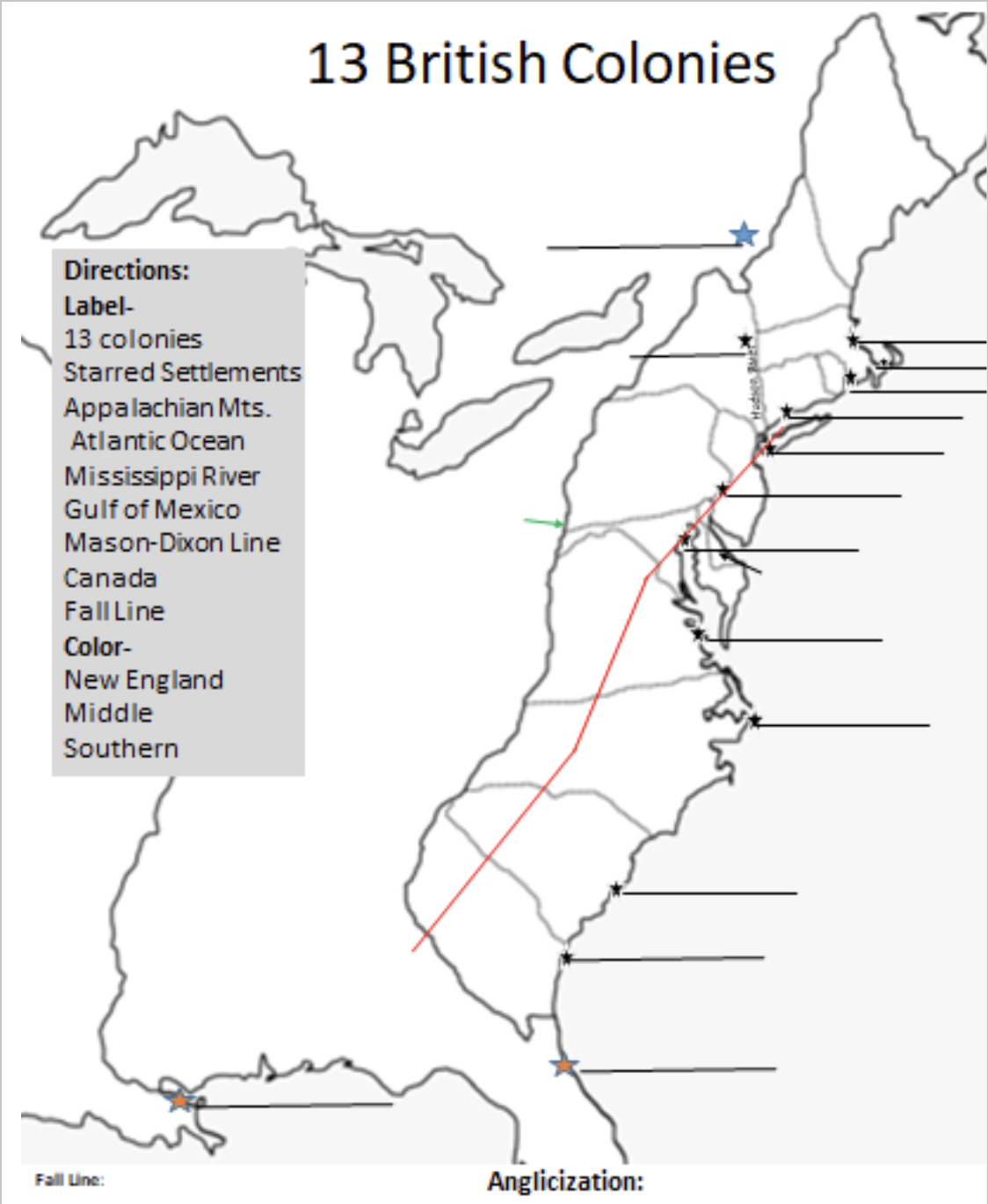
Pin the colonies on the map
The same map as your class worksheet. Drop each colony where it belongs; chips are tinted by region. For the full lab (settlements, rivers, and rival empires), open the 13 Colonies Map Lab after this guide.
Place the 13 colonies
Test yourself: no hints until you check. Purple New England, orange Middle, teal Southern.
Section 2 self-quiz
Chesapeake, New England, and the three regions
0 of 8 answered
- 01
Jamestown was financed by the Virginia Company, which means the colony began as
- 02
What happened in Virginia in 1619 that makes the year a double landmark?
- 03
The Pilgrims of Plymouth differed from the Puritans of Massachusetts Bay because the Pilgrims
- 04
The Mayflower Compact (1620) is historically significant as an early example of
- 05
Roger Williams's Rhode Island stood out among the colonies for its
- 06
Which feature belongs to the MIDDLE colonies?
- 07
Life in the seventeenth-century Chesapeake differed from New England in that Chesapeake settlers
- 08
Harvard College (1636) and New England's town school laws reflect the Puritan belief that
Section 3 · The Atlantic Money Machine
Class statement 2.4
Triangular Trade and Mercantilism
Follow the goods, then follow the rules Britain wrote about the goods, then follow the smuggling around the rules.
3.1 The three routes
Your class statement names three routes. Trace each ribbon below from source to destination; the width shows roughly how much the empire cared about it.
3.2 Mercantilism: the rules of the game
Mercantilism is the theory that colonies exist to benefit the mother country. Wealth is measured in gold and silver, so the empire should export more than it imports, and colonies should feed the machine: sell Britain cheap raw materials, buy Britain’s expensive finished goods, and trade with nobody else. Parliament wrote that theory into law as the Navigation Acts (1651-1673), and the whole system ran downhill from London.
Section 3 self-quiz
Trade and regulation
0 of 6 answered
- 01
Under mercantilist theory, the American colonies existed primarily to
- 02
The Navigation Acts required that
- 03
Which was a genuine colonial BENEFIT of the Navigation Acts?
- 04
The main colonial response to trade regulations they disliked was
- 05
Salutary neglect mattered for later American history mainly because it
- 06
In the New England version of the triangular trade, the three legs carried
Section 4 · Natives and Newcomers
Class statement 2.5
British Actions, Native Reactions
Trade and coexistence kept collapsing into war, because the British model, unlike the French one, ran on taking land.
4.1 The pattern, on both sides
Your class statement is a two-column answer. Learn it as two sets of four.
British actions
- 🗺️ Land acquisition: purchase, treaties, and outright seizure of native lands as the settler population swelled
- 🦫 Trade relationships: the fur trade and exchange of goods (iron tools, cloth, guns for pelts)
- ✝️ Missionary efforts: attempts to convert natives, like John Eliot’s “praying towns” in Massachusetts
- ⚔️ Military conflict: the Pequot War, King Philip’s War, and the frontier violence behind Bacon’s Rebellion
Native reactions
- 🔧 Adaptation: adopting European tools, weapons, and trade goods on their own terms
- 🏹 Resistance: armed conflict and forming confederations to fight back (Powhatan, Metacom)
- 🤝 Diplomacy: treaties, and playing rival European powers against each other
- 🪶 Cultural preservation: maintaining language, religion, and traditions despite relentless pressure
4.2 Two theaters, one pattern
Run the lanes side by side: early cooperation, rising land pressure, then a devastating war in each region within a single year of each other.
4.3 Spotlight: King Philip’s War, 1675-76
My father Massasoit fed these people when they starved. Two generations later they take our land, put our people on trial in their courts, and tell us how to worship. If we do not act as one people now, there will be nothing left to defend.
Metacom built an alliance of Wampanoags, Narragansetts, and others and struck across New England. Over a thousand colonists died and a dozen towns burned. But colonial forces and their Mohawk allies wore the alliance down; Metacom was killed in 1676.
Section 5 · From Servants to Slavery
Class statement 2.6
The Labor Revolution
Tobacco needed hands. For most of a century those hands were English and temporary. Then, in one generation, they became African and permanent. Understanding why is the heart of this unit.
5.1 The four kinds of labor
📜 Indentured servants
Europeans who signed away 4 to 7 years of labor to repay their passage. Roughly three quarters of Chesapeake immigrants in the 1600s came this way. Survivors received “freedom dues” and a shot at land; many died first, and masters controlled everything until the contract ended.
⛓️ Enslaved Africans
Forced labor for life, concentrated in the Southern colonies but present in all thirteen. Defined by slave codes as property, with bondage inherited through the mother. Brutal conditions, family separation, and cultural suppression, answered by constant resistance.
🔨 Free wage labor
Skilled craftsmen, sailors, and hired hands, concentrated in towns and cities. Scarce labor meant colonial wages ran higher than in Europe: the honest half of every recruiting pamphlet.
👨👩👧👦 Family labor
The default in New England and on frontier farms everywhere: parents and children working their own land for subsistence. No wages, no contracts, and no export fortune, but also no master.
5.2 The switch, charted
Watch the Chesapeake workforce transform. Enslaved Africans were a tiny share of Virginia’s population in 1650; by 1750 they were more than two of every five people in the colony.
Enslaved share of Virginia’s population, 1650 to 1750 (percent, historian estimates)
The inflection point sits in the 1680s, right after one event. Your class statement names it directly: Bacon’s Rebellion.
5.3 Bacon’s Rebellion, the mini-cartoon
The single most important cause-and-effect chain in Unit 2. Watch it play out.
Bacon's Rebellion, 1676
5.4 Why the switch? All the reasons
Bacon’s Rebellion is the headline cause, but your class statement asks for the full set. Click through.
5.5 Read the rebellion like a grader
Bacon justified the rising in his Declaration of the People (1676). Hover each highlight for what a top scorer notices.
For having, upon specious pretences of public works, raised great unjust taxes upon the commonalty for the advancement of private favorites and other sinister ends... For having protected, favored, and emboldened the Indians against His Majesties loyal subjects, never contriving, requiring, or appointing any due or proper means of satisfaction for their many invasions, robberies, and murders committed upon us.
5.6 You are Governor Berkeley
It is the spring of 1676. Play the crisis, then read what actually happened.
Jamestown, spring 1676
You are Sir William Berkeley, royal governor of Virginia. Frontier settlers, many of them freed servants who cannot afford tidewater land, are skirmishing with native nations. A young, wealthy, charismatic newcomer named Nathaniel Bacon demands a commission to lead volunteers against the natives, ALL natives, allied or not. The fur trade, the peace treaties, and the colony's order are in your hands.
Sections 4 + 5 self-quiz
Natives, labor, and the great switch
0 of 8 answered
- 01
Which sequence correctly matches British actions with native reactions?
- 02
King Philip's War (1675-76) is significant because it
- 03
Roughly three quarters of seventeenth-century Chesapeake immigrants arrived as
- 04
Bacon's Rebellion revealed which tension in Virginia society?
- 05
The most important long-term consequence of Bacon's Rebellion was
- 06
Colonial slave codes established that enslavement was
- 07
For the enslaved, the impact of the labor system included
- 08
The Stono Rebellion of 1739 led South Carolina to
Section 6 · A New People, New Ideas
Class statement 2.7
Immigration, Awakening, Enlightenment
By 1754 the colonies are not transplanted England anymore. New peoples, a religious earthquake, and a political philosophy are quietly building something American.
6.1 Who the colonists became
The stream below shows the changing makeup of the colonial population from 1660 (left edge) to 1750 (right edge). Watch the English share shrink as Scots-Irish, German, and forced African migration reshape the colonies.
Colonial population share by origin group, 1660 → 1750 (each band is a group; rows run in 15-year steps)
English
The largest group, and the founders of the dominant culture: language, law, and institutions. Everyone else adapted to, resisted, or reshaped an English frame.
Scots-Irish
Presbyterians from northern Ireland who settled the frontier backcountry, from Pennsylvania down the Appalachian valleys. Land-hungry, independent, and quick to clash with natives and eastern elites alike.
Germans
Settled Pennsylvania above all (the “Pennsylvania Dutch,” from Deutsch), keeping distinct communities: their own language, churches (Lutheran, Mennonite, Amish), and famously productive farms.
Africans
The one group that did not choose to come: forced migration through the slave trade, concentrated in the South but present everywhere. African music, religion, food, and language survived bondage and became foundational to American culture.
6.2 The Great Awakening, 1730s-40s
By 1730 the founders’ fire had cooled: church services were formal, membership was slipping, and prosperity was crowding out piety. Then two preachers lit a match.
The God that holds you over the pit of hell, much as one holds a spider or some loathsome insect over the fire, abhors you… yet it is nothing but his hand that holds you from falling every moment.
I preach in fields because the churches cannot hold the crowds. Farmhands and governors weep side by side. It matters nothing what parish you were born in: you must be born again.
Why it happened
- Religious decline: worship in the established churches had grown formal and unemotional
- Social change: growing wealth and materialism crowded out old piety
- Enlightenment influence: rational religion left many hungry for felt, personal faith
What it changed
- Religious revival: emotional, personal conversion experiences for ordinary people
- New denominations: Baptists and Methodists surged; congregations split into New Lights vs Old Lights
- New colleges: Princeton, Brown, Rutgers, Dartmouth, founded to train rival ministries
- Democratic ideals: if you can judge your minister, you can judge your governor: authority became challengeable
- Unity: the first experience shared across all thirteen colonies
6.3 The Enlightenment goes to America
The Great Awakening moved hearts; the Enlightenment armed minds. European thinkers applied reason to government, and colonial elites (none more than Benjamin Franklin) read every word.
flowchart TB
  E[The Enlightenment: reason over tradition]
  L["Natural rights: life, liberty, property (John Locke)"]
  S[Social contract: government by consent of the governed]
  P[Separation of powers: checks and balances]
  R[Reason and science over inherited authority]
  A[Colonial assemblies grow more powerful and independent]
  C[Written constitutions and fundamental laws]
  T[Ideas of religious tolerance and church-state separation]
  Q[Questioning of British authority itself]
  D[Foundation for later American government]
  E --> L
  E --> S
  E --> P
  E --> R
  L --> Q
  S --> A
  P --> C
  R --> T
  A --> D
  C --> D
  T --> D
Q --> DSection 6 self-quiz
Immigration, Awakening, Enlightenment
0 of 6 answered
- 01
The Scots-Irish immigrants of the early 1700s primarily settled
- 02
German immigrants in Pennsylvania were notable for
- 03
Which list gives the impacts of immigration named in your class statement?
- 04
A major cause of the Great Awakening was
- 05
Which was an effect of the Great Awakening?
- 06
John Locke's ideas influenced colonial politics by teaching that
The primary source reader
Flip through the six documents your test is most likely to quote. Each page ends with the reason it gets tested.
Period 2 in six documents
Period 2 Sources
Six documents your test loves
1 · The Mayflower Compact, 1620
'We... covenant and combine ourselves together into a civil body politic... and by virtue hereof to enact, constitute and frame such just and equal laws... as shall be thought most meet and convenient for the general good of the Colony.'
Why it gets tested: self-government created by mutual consent, before any government existed to grant it. Pairs with the House of Burgesses (1619) as the twin roots of American self-rule.
2 · John Winthrop, A Model of Christian Charity, 1630
'We must consider that we shall be as a city upon a hill. The eyes of all people are upon us.'
Why it gets tested: the Puritan mission statement: Massachusetts as a model community under covenant with God. Also the root of a phrase American politicians have quoted ever since.
3 · Maryland Act of Toleration, 1649
'No person... professing to believe in Jesus Christ, shall from henceforth be any ways troubled, molested or discountenanced for... his or her religion nor in the free exercise thereof.'
Why it gets tested: an early legal protection of (Christian-only) religious freedom, passed to shield Maryland's Catholic minority. Know both the milestone and the limit.
4 · Nathaniel Bacon, Declaration of the People, 1676
'For having, upon specious pretences of public works, raised great unjust taxes upon the commonalty for the advancement of private favorites...'
Why it gets tested: class conflict inside colonial society: frontier ex-servants vs the tidewater elite. The rebellion's aftermath, the shift toward enslaved labor, is the exam's favorite cause-and-effect chain in this unit.
5 · Olaudah Equiano on the Middle Passage, 1789
'The closeness of the place, and the heat of the climate... almost suffocated us... The shrieks of the women, and the groans of the dying, rendered the whole a scene of horror almost inconceivable.'
Why it gets tested: the human reality inside the triangular trade's third leg. Written later, but describing this period's system: check the date when classifying the source.
6 · Jonathan Edwards, Sinners in the Hands of an Angry God, 1741
'The God that holds you over the pit of hell, much as one holds a spider... abhors you, and is dreadfully provoked.'
Why it gets tested: the Great Awakening's emotional style in one sentence. Distinguish it from Enlightenment reasoning, and connect it to new denominations, new colleges, and challenged authority.
Page 1 of 6
1 · The Mayflower Compact, 1620
'We... covenant and combine ourselves together into a civil body politic... and by virtue hereof to enact, constitute and frame such just and equal laws... as shall be thought most meet and convenient for the general good of the Colony.'
Why it gets tested: self-government created by mutual consent, before any government existed to grant it. Pairs with the House of Burgesses (1619) as the twin roots of American self-rule.
Page 2 of 6
2 · John Winthrop, A Model of Christian Charity, 1630
'We must consider that we shall be as a city upon a hill. The eyes of all people are upon us.'
Why it gets tested: the Puritan mission statement: Massachusetts as a model community under covenant with God. Also the root of a phrase American politicians have quoted ever since.
Page 3 of 6
3 · Maryland Act of Toleration, 1649
'No person... professing to believe in Jesus Christ, shall from henceforth be any ways troubled, molested or discountenanced for... his or her religion nor in the free exercise thereof.'
Why it gets tested: an early legal protection of (Christian-only) religious freedom, passed to shield Maryland's Catholic minority. Know both the milestone and the limit.
Page 4 of 6
4 · Nathaniel Bacon, Declaration of the People, 1676
'For having, upon specious pretences of public works, raised great unjust taxes upon the commonalty for the advancement of private favorites...'
Why it gets tested: class conflict inside colonial society: frontier ex-servants vs the tidewater elite. The rebellion's aftermath, the shift toward enslaved labor, is the exam's favorite cause-and-effect chain in this unit.
Page 5 of 6
5 · Olaudah Equiano on the Middle Passage, 1789
'The closeness of the place, and the heat of the climate... almost suffocated us... The shrieks of the women, and the groans of the dying, rendered the whole a scene of horror almost inconceivable.'
Why it gets tested: the human reality inside the triangular trade's third leg. Written later, but describing this period's system: check the date when classifying the source.
Page 6 of 6
6 · Jonathan Edwards, Sinners in the Hands of an Angry God, 1741
'The God that holds you over the pit of hell, much as one holds a spider... abhors you, and is dreadfully provoked.'
Why it gets tested: the Great Awakening's emotional style in one sentence. Distinguish it from Enlightenment reasoning, and connect it to new denominations, new colleges, and challenged authority.
Test-taking machine
Worked example: beating a stimulus question
The routine from Unit 1, run on a Unit 2 source. Four steps, every time.
Practice: SAQ drills from your class statements
These mirror the study guide statements exactly. Write your answer in complete sentences, then open the model.
Q 2.2: Explain ONE similarity and ONE difference between British colonization and that of ONE other European power.
Similarity: every power (British, Spanish, French, Dutch) colonized for economic gain, empire, religion, and exploration. Difference (pick your pair): Britain planted permanent, family-based farming settlements along the Atlantic coast, while Spain relied on conquest, missions, and forced native labor in the Southwest and Florida; or while France built a thinly-populated fur-trade network of posts and native alliances along the Great Lakes and Mississippi; or while the Dutch ran a single diverse commercial port (New Amsterdam) through the Dutch West India Company.
Q 2.3: Explain ONE social, ONE political, and ONE economic difference between the Chesapeake and New England colonies.
Social: the Chesapeake was a male-heavy, short-lived society of scattered plantations built on servant (later enslaved) labor, while New England was settled by healthy, long-lived family units in compact towns. Political: Virginia developed the House of Burgesses under royal control dominated by planters, while New England ran on town meetings and compact-based self-government (Mayflower Compact, Fundamental Orders). Economic: the Chesapeake bet everything on the tobacco cash crop, while New England mixed subsistence farming with fishing, lumber, shipbuilding, and trade. (Geography drove all three: warm fertile river country vs rocky soil and good harbors.)
Q 2.4: Describe the triangular trade and explain how Britain tried to regulate colonial commerce.
The triangular trade moved raw materials (tobacco, rice, lumber, fish) from the colonies to Europe, manufactured goods (cloth, guns, tools) from Europe to Africa, and enslaved Africans across the Middle Passage to the Americas, with a New England variant running molasses to rum to enslaved people. Britain regulated it under mercantilism (colonies exist to benefit the mother country) through the Navigation Acts (1651-1673): trade in British ships, enumerated goods like tobacco sold only to Britain, imports routed through British ports. The impact your statement names: resentment and smuggling, tolerated for decades under salutary neglect.
Q 2.5: Identify TWO British actions toward Native Americans and TWO native reactions, with an example of each.
British actions: land acquisition by purchase, treaty, and seizure (the constant pressure behind every conflict); trade (furs for iron goods); missionary efforts (John Eliot’s praying towns); military conflict (Pequot War 1637, King Philip’s War 1675-76). Native reactions: adaptation (adopting European tools and guns); resistance and confederation (Metacom’s alliance, the Powhatan uprisings); diplomacy (allying with one European power against another); cultural preservation (maintaining language, religion, and traditions under pressure).
Q 2.6: Explain why the Chesapeake shifted from indentured servitude to African slavery, and the impact on the laborers.
Reasons: Bacon’s Rebellion (1676) showed the danger of a large class of armed, landless ex-servants; tobacco and rice demanded ever more labor while fewer English signed indentures; and racial ideology, written into slave codes, made African bondage permanent and hereditary. Impact: surviving indentured servants eventually gained freedom and sometimes modest prosperity; free workers found better opportunities than in Europe; enslaved people faced brutal conditions, family separation, and cultural suppression for life, and resisted through means from slowdowns to the Stono Rebellion (1739).
Q 2.7: Explain ONE cause and TWO effects of the Great Awakening, and ONE way the Enlightenment shaped colonial politics.
Cause (any one): formal, unemotional worship in established churches; rising wealth and materialism; rationalist Enlightenment religion leaving people hungry for emotional faith. Effects (any two): emotional revival and personal conversion; growth of Baptists and Methodists and the New Light/Old Light split; new colleges (Princeton, Brown, Rutgers, Dartmouth); challenges to established authority; the first shared intercolonial experience. Enlightenment: Locke’s natural rights and social contract taught that government rests on consent, strengthening colonial assemblies, inspiring written constitutions and religious tolerance, and providing the vocabulary for resistance to British authority in Unit 3.
The whole unit in one map
Match the colony to its founder and purpose
Put the unit in order
- Maryland's Act of Toleration (1649)
- England seizes New Amsterdam (1664)
- First Navigation Act passed (1651)
- King Philip's War and Bacon's Rebellion (1675-76)
- Winthrop leads the Puritans to Massachusetts Bay (1630)
- Zenger acquitted; press freedom advances (1735)
- House of Burgesses meets; first Africans arrive (1619)
- Pequot War in New England (1637)
- Pilgrims sign the Mayflower Compact (1620)
- Penn founds Pennsylvania (1681)
- Jamestown founded by the Virginia Company (1607)
- Stono Rebellion; Great Awakening peaks (1739-41)
Mock unit test
Twenty-five questions, AP-paced. Set the timer, no notes, and run the four-step routine on every stimulus-flavored question.
Test timer
25-minute time limit. Click Start when you begin.
Unit 2 mock test, 25 questions
0 of 25 answered
- 01
All four colonizing powers (Spain, France, the Netherlands, Britain) shared which motivation?
- 02
Spanish colonization is best characterized by
- 03
France's colonial presence in North America was concentrated in
- 04
The Dutch colony of New Netherland was distinctive for its
- 05
Jamestown's survival was ultimately secured by
- 06
Both the House of Burgesses (1619) and the Mayflower Compact (1620) illustrate
- 07
The Puritans of Massachusetts Bay came to America primarily to
- 08
Roger Williams and Anne Hutchinson are similar in that both
- 09
The Fundamental Orders of Connecticut (1639) is significant as
- 10
A test question describes a colony of religious pluralism, wheat exports, and a great port city founded by Quakers. It is describing
- 11
The three legs of the classic triangular trade carried
- 12
Under the Navigation Acts, enumerated goods such as tobacco
- 13
The overall purpose of Britain's mercantilist regulations was to
- 14
Colonists most commonly responded to the Molasses Act of 1733 by
- 15
John Eliot's 'praying towns' are an example of which British action toward natives?
- 16
King Philip's War and Bacon's Rebellion, both peaking in 1675-76, shared which underlying cause?
- 17
One native reaction to European pressure that your class statement highlights was
- 18
An indentured servant in the seventeenth-century Chesapeake typically
- 19
Planters shifted from indentured servants to enslaved Africans partly because Bacon's Rebellion showed that
- 20
Colonial slave codes made slavery
- 21
The Scots-Irish contribution to colonial development most associated with your class statement is
- 22
The Great Awakening contributed to the coming Revolution most directly by
- 23
Jonathan Edwards and George Whitefield are both associated with
- 24
Locke's social contract theory holds that government derives its authority from
- 25
The Zenger case of 1735 advanced the colonial principle that
Flashcards: the full deck
Signed in, these schedule themselves with spaced repetition and feed your daily review queue.
Flashcards
1 / 39 · browse mode
Ratings schedule next review · view all due cards
Mnemonics
Four empires
Swords, Furs, Florins, Farms
Spain swords (conquest), France furs (trade), Dutch florins (money, a company colony), Britain farms (families who stayed).
New England colonies
New Hampshire’s Mad Rhode Chickens
New Hampshire, Massachusetts, Rhode Island, Connecticut. Purple on your class map.
Middle colonies
No Jersey Pennies, Dear
New York, New Jersey, Pennsylvania, Delaware. Orange on your class map: the breadbasket.
Navigation Acts
Ships, Sales, Stops
British ships only. Enumerated sales only to Britain. All imports stop in British ports first.
The 1619 double
Votes and chains, same summer
House of Burgesses AND the first enslaved Africans, both 1619, both Virginia. The exam loves the pairing; so should you.
The twin wars of 1676
Philip fought, Bacon burned
King Philip’s War (New England) and Bacon’s Rebellion (Virginia) peak together in 1675-76, and both grow from settler land hunger.
Immigration impact
D-E-R-W
Diversity, Economic growth, Religious pluralism, Westward expansion: your statement’s four impacts, in order.
Awakening vs Enlightenment
Heart vs Head, same target
The Awakening challenged authority through the heart (emotion, conversion); the Enlightenment through the head (reason, rights). Both loosened deference before 1754.
Common pitfalls
They came to practice their own faith purely, and banished dissenters like Roger Williams and Anne Hutchinson. Genuine religious liberty in this period lives in Rhode Island (full liberty) and, in limited Christian form, Maryland (1649) and Pennsylvania. If a question says “toleration,” check which colony before answering.
Both were Calvinists, but the Pilgrims (Plymouth, 1620) were Separatists who abandoned the Church of England, while the Puritans (Massachusetts Bay, 1630) meant to purify it from within. Separate colonies, separate leaders, ten years apart.
It is a model of many overlapping circuits: the classic Europe-Africa-Americas triangle, the New England molasses-rum-slaves loop, and plenty of direct two-way routes. Use the model to organize the flows, but remember the exam may show any leg. The constant is the Middle Passage: the leg that carried people.
Slavery was legal in all thirteen colonies in this period. It was concentrated in the South (tobacco, rice, indigo), but New York City had one of the largest enslaved populations in the colonies, and New England merchants profited from the trade itself.
It was mostly freed and current indentured servants plus frontier farmers (some enslaved men joined late) revolting against Berkeley’s elite government and its native policy. Its connection to slavery is as a cause: it frightened planters into replacing servants with enslaved Africans.
Opposite methods, overlapping effect. The Awakening was emotional religion (Edwards, Whitefield); the Enlightenment was rational philosophy (Locke, Franklin). Both taught colonists to question established authority, which is why they share a class statement, and an exam question.
Cheat sheet
The whole unit on one rail, two tables, and one recall drill. Print-brain material.
Dates that decide questions
| Year | Event | One-line significance |
|---|---|---|
| 1607 | Jamestown | First permanent English colony; joint-stock, profit-driven |
| 1619 | Burgesses + first Africans | Self-government and slavery arrive together |
| 1620 | Mayflower Compact | Government by consent, signed at sea |
| 1630 | Massachusetts Bay | Winthrop’s city upon a hill; Great Migration |
| 1636-39 | RI, CT, Harvard | Dissenters’ colonies; first written constitution |
| 1649 | Act of Toleration | Maryland protects (Christian) worship |
| 1651-73 | Navigation Acts | Mercantilism becomes law; smuggling becomes lifestyle |
| 1664 | New Amsterdam falls | Dutch colony becomes New York |
| 1675-76 | King Philip’s War | Native power in New England broken |
| 1676 | Bacon’s Rebellion | Class revolt; pivot from servants to slavery |
| 1681 | Pennsylvania | Penn’s tolerant, diverse Holy Experiment |
| 1733 | Georgia + Molasses Act | Last colony; most-smuggled tax in America |
| 1735 | Zenger verdict | Truth defeats libel; free press takes root |
| 1739 | Stono Rebellion | Largest slave uprising; harsher codes follow |
| 1730s-40s | Great Awakening | Edwards + Whitefield; authority challenged, colonies united |
| 1754 | French and Indian War | Period ends; Unit 3 begins |
The three-region comparison
| New England | Middle | Southern | |
|---|---|---|---|
| Society | Puritan family towns | Most diverse, tolerant | Planter elite over enslaved majority-labor |
| Politics | Town meetings, assemblies | Proprietary + elected assemblies | Planter-controlled government |
| Religion | Puritan (Congregational) | Pluralist (Quakers +) | Anglican, honor culture |
| Economy | Farms, fish, ships, trade | Breadbasket wheat + trade | Tobacco, rice, indigo |
| Settlement | Compact towns | Cities (Philadelphia, NY) | Scattered plantations |
| Geography | Rocky, cold, harbors | Fertile, mild, rivers | Warm, fertile coastal plains |
Cold-recall drill
Work the modes left to right: read, cloze, first letters, then say it cold.
Unit 2 cold-recall sheet
Key terms by class statement
Vocab crossword
Short answer (AI graded)
Write real paragraphs in your own words. The tutor scores each out of 5 and tells you what a grader would dock.
Unit 2 short answer
AI-graded. Score and feedback after each submission.
PUBLIC_AI_TUTOR_URL.
Fill in the blanks
Last recall pass on the numbers and names.
Dates, names, systems
0 of 0 correct
Study session
Which Unit 2 topic feels shakiest right now?
”We must consider that we shall be as a city upon a hill. The eyes of all people are upon us.”
John Winthrop, 1630. Thirteen very different colonies spent 147 years deciding what that hill would look like.