
Romeo and Juliet: Love, Fate, and Five Days That Doomed Verona
A complete interactive deep dive into Shakespeare's tragedy: plot, characters, themes, language, devices, every famous quote unpacked, and a memorize-the-balcony-scene practice tool.
Learning objectives
After this guide you will be able to:
- Reconstruct the 5-day plot in order without notes
- Identify every major character, their family alignment, and their fate
- Explain the four major themes with supporting quotes
- Recognize and name the eight literary devices Shakespeare uses most
- Unpack ten of the play’s most famous quotes, line by line
- Recite at least the first eight lines of Romeo’s balcony soliloquy from memory
- Distinguish what is Shakespeare’s invention from what he borrowed
TL;DR
Two teenagers from feuding families in Renaissance Verona meet at a party, secretly marry the next day, and are dead within five days. The play is less about love than about how a generations-old grudge corrupts the institutions (family, church, state) supposed to protect young people. Net summary:
Glossary
- Verona
- Star-crossed
- Blank verse
- Iambic pentameter
- Sonnet
- Foil
- Oxymoron
- Pun
- Soliloquy
- Aside
- Dramatic irony
- Foreshadowing
- Catastrophe
- Aubade
- Friar
Vocab crossword
A quick check on the glossary terms above. Click a clue, type your answer in the grid, then hit Check.
The Prologue, close-read
Shakespeare opens the play with a 14-line sonnet spoken by a Chorus. It tells you the setting, the characters, and the ending in 116 words. Read it once for sound, then look at the highlighted phrases below to see what each one is doing.
Two households, both alike in dignity, In fair Verona, where we lay our scene, From ancient grudge break to new mutiny, Where civil blood makes civil hands unclean. From forth the fatal loins of these two foes A pair of star-cross'd lovers take their life; Whose misadventured piteous overthrows Do with their death bury their parents' strife. The fearful passage of their death-mark'd love, And the continuance of their parents' rage, Which, but their children's end, nought could remove, Is now the two hours' traffic of our stage; The which if you with patient ears attend, What here shall miss, our toil shall strive to mend.
Annotate it yourself
Pick a phrase in the Prologue below that struck you, select it with your cursor, and write your own note. Your highlights are saved on this device.
Select any span of text to add a note. Your notes are saved locally to this browser.
Two households, both alike in dignity, In fair Verona, where we lay our scene, From ancient grudge break to new mutiny, Where civil blood makes civil hands unclean. From forth the fatal loins of these two foes A pair of star-cross'd lovers take their life; Whose misadventured piteous overthrows Do with their death bury their parents' strife. The fearful passage of their death-mark'd love, And the continuance of their parents' rage, Which, but their children's end, nought could remove, Is now the two hours' traffic of our stage; The which if you with patient ears attend, What here shall miss, our toil shall strive to mend.
The 5-day timeline
Most students do not realize the entire play unfolds in less than 100 hours. From their first kiss to their joint suicide is barely 4 days.
The cast: who’s who
Verona, the real place
Verona was a real Italian city when Shakespeare wrote, and remains one of the most-visited literary destinations on Earth. The play’s locations map to actual streets you can walk today.
Plot structure: Freytag’s pyramid
Every classical tragedy follows the same five-part shape. Romeo and Juliet maps cleanly to it, with one act per phase.
flowchart LR
  E[Act 1<br/>Exposition] --> R[Act 2<br/>Rising action]
  R --> C[Act 3<br/>Climax]
  C --> F[Act 4<br/>Falling action]
F --> Cat[Act 5<br/>Catastrophe]| Act | Phase | What happens |
|---|---|---|
| 1 | Exposition | Setting, feud, characters introduced. Romeo meets Juliet at the party. |
| 2 | Rising action | Balcony, secret marriage. Hope is at its peak. |
| 3 | Climax | Mercutio dies. Romeo kills Tybalt. Banishment. Everything turns. |
| 4 | Falling action | The Friar’s plan. Juliet drinks the potion. The plan starts to slip. |
| 5 | Catastrophe | Failed letter. Tomb scene. Both lovers dead. Families reconcile. |
The death cascade
Trace each death back to its trigger and you can see the whole tragedy as a chain reaction. This Sankey diagram shows how one event causes the next.
Walk through the catastrophe, step by step
The Sankey above shows the chain at a glance. Click through this sequence to see each link individually. Useful for essay outlines: each step is a paragraph topic.
Themes: the big four
1. Love (and its many forms)
The play presents at least five kinds of love, often in the same scene:
- Courtly love: Romeo’s mooning over Rosaline. Performative, idealized, suffering-as-status.
- Romantic love: Romeo and Juliet after they meet. Sudden, mutual, transformative.
- Sexual love: the Nurse’s bawdy humor; Mercutio’s puns; the wedding night.
- Parental love: distorted by patriarchy. Lord Capulet calls Juliet “my child” then threatens to disown her two scenes later.
- Friendly love: Romeo and Mercutio; Juliet and the Nurse. These are the play’s emotional ballast.
2. Fate vs. free will
The Prologue calls them “star-crossed”. Romeo cries “I am fortune’s fool!” Juliet asks her balcony, “O Romeo, Romeo, wherefore art thou Romeo?” The play insists fate is in charge.
But every disaster also has a clear human cause. The feud is human. Tybalt’s pride is human. The Friar’s risky plan is human. Romeo’s impulsivity is human. Shakespeare gives you both readings simultaneously and refuses to resolve them.
3. Violence and honor (toxic masculinity, before the term existed)
Look at how often men in this play threaten to fight to defend their masculinity:
- The opening scene: servants brawl over thumb-biting
- Tybalt cannot let Romeo’s party-crashing slide
- Mercutio cannot let Tybalt insult Romeo go unanswered
- Romeo cannot live with Mercutio’s death unavenged
Each of these decisions kills someone. The play is brutally clear: honor culture is what murders these characters.
4. Youth vs. age
Almost every adult in the play (Friar, Nurse, parents, Prince) tries to manage the lovers and fails. Their advice is sensible but slow; the lovers are reckless but sincere. The play does not take a side: both ages are responsible for the catastrophe.
Themes at a glance
This mind map links every theme to the scenes and lines that prove it. Click any node to expand or collapse a branch.
The shared sonnet (Act 1, Sc 5)
The very first words Romeo and Juliet say to each other are a complete Shakespearean sonnet built from their alternating lines. This is one of the most virtuosic moves in all of theater: the lovers literally finish each other’s poetry.
ROMEO: If I profane with my unworthiest hand This holy shrine, the gentle sin is this: My lips, two blushing pilgrims, ready stand To smooth that rough touch with a tender kiss.
JULIET: Good pilgrim, you do wrong your hand too much, Which mannerly devotion shows in this; For saints have hands that pilgrims’ hands do touch, And palm to palm is holy palmers’ kiss.
ROMEO: Have not saints lips, and holy palmers too?
JULIET: Ay, pilgrim, lips that they must use in prayer.
ROMEO: O, then, dear saint, let lips do what hands do; They pray, grant thou, lest faith turn to despair.
JULIET: Saints do not move, though grant for prayers’ sake.
ROMEO: Then move not, while my prayer’s effect I take. [Kisses her]
Rhyme scheme: ABAB CDCD EFEF GG (the Shakespearean sonnet form). The shared metaphor is pilgrim → saint → prayer: Romeo casts himself as a religious pilgrim seeking the sacred, and Juliet plays along until the kiss “answers” his prayer. The first kiss in literary history that arrives at the end of a perfect 14-line poem.
Iambic pentameter, hands-on
Every Shakespearean line has a beat. Iambic pentameter is five iambs in a row: ten syllables alternating unstressed-STRESSED.
Try clapping the rhythm of Romeo’s most famous line:
But SOFT, what LIGHT through YON-der WIN-dow BREAKS?
da-DUM da-DUM da-DUM da-DUM da-DUM
When Shakespeare breaks the meter, it almost always means something. A line with a missing or extra beat is often a moment of high emotion, interruption, or character revealing themselves.
What the play talks about
A weighted view of the play’s vocabulary. Bigger words are spoken more often. Notice how love, night, and name dominate, while fortune and fate appear constantly in the background.
The balcony scene
This is the most famous scene in English drama. Watch a production once, then we’ll memorize it.
Watch the balcony scene
A full performance of the balcony scene. Watch it once before the close-reading and memorization sections below.
Scrolling the whole balcony scene
The graphic above stays pinned while you scroll through 13 annotated cards. Each card highlights a key line from the assigned passage and explains the device or image it uses. The stage automatically switches sections (Part 1 to Part 5) as you reach each new chunk.
"But, soft!"
The line opens with a beat-break: BUT, SOFT, two stressed syllables back-to-back. Shakespeare uses this when a character is suddenly arrested by what they see. Romeo is mid-thought when Juliet appears at the window.
"Juliet is the sun."
Romeo crowns Juliet a heavenly body. This single metaphor sets up the entire light-vs-dark imagery system that runs through the rest of the play. Juliet is light; the night and the moon are her enemies.
The envious moon
The moon is the goddess Diana, who represents virginity. Romeo wants Juliet to "kill" it, meaning give up her chaste status. This is a young man's seduction speech dressed up as cosmology.
"Vestal livery"
"Vestal" refers to the Vestal Virgins of Rome who tended a sacred fire. "Livery" is a uniform. Romeo is asking Juliet to take off her virginity like a costume. The Elizabethan audience would have caught the bawdy second meaning instantly.
"It is my lady."
Romeo finally lets himself say it. Up to now he's used metaphor (sun, moon, stars) to keep distance. The plain four words "It is my lady" mark the moment he commits emotionally.
Eyes as stars
Romeo invents an entire conceit: two stars have business elsewhere and ask Juliet's eyes to fill in for them. He then argues her eyes would shine SO bright that birds would sing thinking it was day. Hyperbole stacked on hyperbole.
"O, that I were a glove upon that hand"
The famous line. Romeo wishes to be the most intimate ordinary object: a glove she'd wear, so he could touch her cheek. The wish is at once tender and surprisingly carnal.
"Bright angel"
After Juliet sighs ("Ay me"), Romeo answers her aloud. He shifts from cosmic imagery (sun, stars) to religious imagery (angel, messenger of heaven). Juliet is now both the heavens and the divine.
The winged messenger
The reference is to Gabriel or another angel. Romeo describes mortals tilting their heads back to gaze at the angel as he sails on clouds. He's comparing Juliet on her balcony to a divine apparition over a crowd of upturned faces.
"Wherefore art thou Romeo?"
The most-misquoted line in English. Wherefore means why, not where. Juliet, still believing she is alone, is asking the universe why he has to be a Montague. The pain is in the name, not in his location.
"I'll no longer be a Capulet."
Juliet offers, alone in her room, to give up her own family for him. This is a 13-year-old making the largest possible offer her culture allows. The play tracks how the adults around her fail to honor that offer.
"That which we call a rose..."
The defining line of the speech and one of the most quoted in all literature. Juliet argues that names are arbitrary. The flower would smell the same with any label; Romeo is the same person regardless of being a Montague.
"Doff thy name, take all myself"
"Doff" means take off, like a hat. Juliet asks Romeo to shed his last name and, in exchange, she will give him every part of herself. The moment her speech ends, Romeo steps out of the dark and accepts the bargain.
Memorize the balcony scene
The teacher-assigned passage covers Act 2 Scene 2, lines 1–52. It’s broken into five chunks below in dramatic order. Memorize them one at a time. Each card has its own progress saved on this device.
Part 1: Romeo, “But soft” (lines 2-9)
Romeo, hidden in the orchard, sees a light come on in Juliet’s window.
Romeo discovers Juliet
Act 2, Scene 2, lines 2-9
Part 2: Romeo, “It is my lady” (lines 10-26)
Juliet steps onto the balcony but doesn’t speak. Romeo unfolds an extended metaphor of her eyes outshining the stars and ends wishing he were the glove on her hand.
Romeo wishes to be a glove
Act 2, Scene 2, lines 10-26
Part 3: Romeo, “Bright angel” (lines 28-35)
Juliet sighs (“Ay me”). Romeo, still hidden, answers her aloud.
Romeo answers the bright angel
Act 2, Scene 2, lines 28-35
Part 4: Juliet, “Wherefore art thou Romeo?” (lines 36-39)
Juliet, still believing she is alone, speaks the most-misquoted line in English. “Wherefore” means why, not where.
Juliet on Romeo's name
Act 2, Scene 2, lines 36-39
Part 5: Juliet, “What’s in a name” (lines 41-52)
Juliet keeps musing on the absurdity of names dictating love. The “rose” line is one of the most famous in all of Shakespeare.
What's in a name?
Act 2, Scene 2, lines 41-52
Hear it spoken
Inside the Globe Theatre
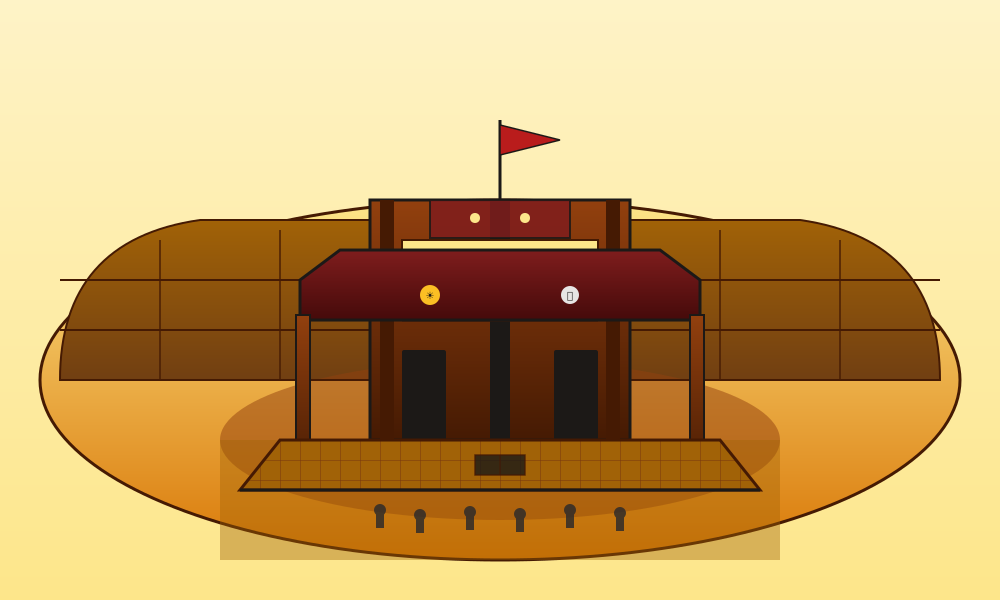
When the play first ran in 1597, it was performed at an open-air theater that looked nothing like a modern stage. The “balcony” was the upper acting space at the back of the stage. The audience surrounded the actors on three sides. The roof over the stage was painted with the sun, moon, and stars.
Drag to rotate, scroll to zoom, click any pin to read what that part of the building did. Use the Audience, Stage, or Bird’s eye buttons to jump to a preset view.
Famous quotes unpacked
Ten quotes every English student should be able to identify, attribute, and analyze.
Q 1. "From forth the fatal loins of these two foes / A pair of star-crossed lovers take their life." - The Chorus, Prologue
Where: the opening Prologue, before the play begins. Meaning: the Chorus tells the audience the ending in the first 14 lines. The lovers are doomed by fate (“star-crossed”) and the feud (“fatal loins of these two foes”). The play is not a mystery, it is an inevitability. Device: dramatic irony built into the structure. The audience knows; the characters do not. Why it matters: Shakespeare is telling you that how this happens, not what happens, is the point.
Q 2. "O Romeo, Romeo, wherefore art thou Romeo?" - Juliet, Act 2, Scene 2
Where: the balcony, alone, before she knows Romeo is below. Meaning: “wherefore” means why, not where. She is asking why he has to be a Montague. She wishes he could shed his name so the feud would not stand between them. Device: soliloquy, plus a meditation on identity vs. label (“a rose by any other name would smell as sweet”). Why it matters: the most-misquoted line in English. She is not searching for him, she is asking the universe why love and family have to be enemies.
Q 3. "These violent delights have violent ends." - Friar Lawrence, Act 2, Scene 6
Where: moments before he marries them in his cell. Meaning: sudden, intense pleasures burn themselves out fast. The Friar is begging Romeo to slow down. Device: antithesis (delight/end), alliteration (violent… violent), and brutal foreshadowing. Why it matters: the Friar predicts the catastrophe in the same scene he enables it. The play is full of these self-aware adults who do the wrong thing anyway.
Q 4. "A plague o' both your houses!" - Mercutio, Act 3, Scene 1
Where: dying from Tybalt’s stab wound. Meaning: Mercutio is neither a Capulet nor a Montague. He is the Prince’s kinsman. Both houses pulled him into a fight that was not his, and he curses them with his last breath. Device: a literal curse, and dramatic irony, the curse comes true. The plague then delays Friar John’s letter in Act 5, killing the lovers. Why it matters: Shakespeare sets up the cause of every later death in this one line. The curse is the play’s mechanism.
Q 5. "I am fortune's fool!" - Romeo, Act 3, Scene 1
Where: standing over Tybalt’s body, having just realized what he has done. Meaning: he is the plaything of fate. The same fortune that gave him Juliet now ruins him. Device: personification of fortune, plus a callback to the Prologue’s “star-crossed” framing. Why it matters: Romeo finally adopts the fate reading of his own life. After this line, he stops trying to choose and starts being chosen.
Q 6. "Wilt thou be gone? It is not yet near day." - Juliet, Act 3, Scene 5
Where: dawn after their wedding night. Romeo must flee for Mantua. Meaning: she is begging him to stay, insisting the lark they hear is actually the nightingale so it cannot be morning yet. Device: an aubade, the dawn-parting poem. Shakespeare inverts the convention: usually the woman urges the man to leave before her husband wakes. Here she urges him to stay even though staying means death. Why it matters: their last conversation alive together. Every word lands harder when you remember that.
Q 7. "Tempt not a desperate man." - Romeo, Act 5, Scene 3
Where: at the tomb, to Paris, who is trying to arrest him. Meaning: literal warning: I have nothing to lose, do not push me. Romeo wants Paris gone so he can die beside Juliet without committing another murder. Device: dramatic irony, Paris does not know Juliet is “dead” because of Romeo. Foreshadowing, “desperate” comes from Latin desperare, “to lose hope.” Romeo names his own state. Why it matters: Romeo, the courtly lover of Act 1, has become a killer. The play tracks his moral decline in three sentences.
Q 8. "Eyes, look your last! / Arms, take your last embrace! and, lips, O you / The doors of breath, seal with a righteous kiss / A dateless bargain to engrossing death!" - Romeo, Act 5, Scene 3
Where: kneeling beside Juliet’s body, about to drink the poison. Meaning: he addresses his own body parts in farewell. He is treating his suicide as a legal contract (“dateless bargain”) with death itself. Device: apostrophe (talking to absent things), personification of death, financial metaphor (“bargain”, “engrossing”). Why it matters: Romeo has been speaking the language of religion (pilgrim, saint, shrine) since Act 1. Here he switches to the language of contracts. Love has become a deal he cannot escape.
Q 9. "Yea, noise? then I'll be brief. O happy dagger! / This is thy sheath; there rust, and let me die." - Juliet, Act 5, Scene 3
Where: waking in the tomb, finding Romeo dead, hearing the Watchmen approach. Meaning: she has seconds. She seizes Romeo’s dagger and stabs herself, calling the dagger “happy” (lucky) because it lets her join him. Device: oxymoron (“happy dagger”), sexual undertone (“sheath” was Elizabethan slang for the female body). Her death is framed as a kind of consummation. Why it matters: Juliet’s suicide is active, not passive. She makes a choice. Romeo dies passively poisoned; Juliet dies fighting to be with him.
Q 10. "For never was a story of more woe / Than this of Juliet and her Romeo." - Prince Escalus, Act 5, Scene 3
Where: the closing couplet of the play. Meaning: the Prince closes the play with a rhyming heroic couplet that frames the story as the saddest ever told. He puts Juliet’s name first, an ordering reversal of the title that gives her the final emphasis. Device: heroic couplet (closing the play in formal verse), superlative (“more woe”), inversion of the play’s title. Why it matters: the final word is Romeo’s but the structure of the line gives Juliet the emotional weight. Shakespeare quietly tilts the play’s title in her favor at the very end.
Literary devices catalog
| Device | Where it appears | Why Shakespeare uses it |
|---|---|---|
| Foreshadowing | The Prologue announces the deaths in line 6 | Frees the audience from suspense so they focus on how fate unfolds |
| Dramatic irony | We know Juliet faked her death; Romeo doesn’t | Maximum tragic tension in the tomb scene |
| Oxymoron | Romeo’s “loving hate, heavy lightness” | Marks immature, performative love |
| Pun | Mercutio’s “ask for me tomorrow and you shall find me a grave man” | Masks pain with wit, Mercutio’s signature |
| Soliloquy | Romeo’s “But soft” speech | Lets the audience inside a private mind |
| Aside | Lord Capulet’s threats during the Paris negotiation | Shows what characters hide from each other |
| Aubade | The lark/nightingale debate, Act 3 Sc 5 | Compresses an entire genre into a parting scene |
| Antithesis | ”These violent delights have violent ends” | Frames the play’s central paradox: love and death together |
Character speaking time
A few stats that surprise most students. Counting lines:
Character relationships at a glance
This chord diagram shows who interacts with whom most. Larger arcs = more shared scene time.
Tension over the 5 days
Plot tension is not flat. It builds, peaks at the climax (Mercutio’s death), then surges again at the catastrophe.
Practice: drag-to-match
Match the character to their defining action
Drag to match
Match the theme to its quote
Drag to match
Match the device to its example
Drag to match
Order the events of the play
Drag the eight events into the order Shakespeare puts them. Hit Check when you think you have it.
Earliest at the top, latest at the bottom.
- Servants brawl in the marketplace; the Prince threatens death to anyone who keeps the feud alive
- Friar John is quarantined and the letter never reaches Romeo
- The tomb scene and the families' reconciliation
- Friar Lawrence gives Juliet the sleeping potion
- Romeo crashes the Capulet party and meets Juliet
- The balcony scene: Romeo and Juliet vow to marry
- Friar Lawrence secretly marries them in his cell
- Mercutio is killed; Romeo kills Tybalt and is banished
Match each character to their defining trait
Click a term, then its match. Get all of them green to clear the board.
Practice: collapsible Q&A
Q Who is more responsible for the deaths: the lovers, the parents, or the Friar?
The play deliberately spreads blame. The lovers are reckless; the parents maintain a feud and force Juliet’s marriage to Paris; the Friar improvises a plan that depends on a single letter arriving on time. Shakespeare’s answer is “all of them, plus chance.” A good essay argues for primary responsibility while acknowledging the others.
Q Why did Shakespeare set the play in Italy?
Three reasons. (1) His direct source (Brooke’s poem) was set there. (2) For Elizabethan audiences, Italy meant passion, vendetta, and Catholic mystery, the perfect setting for an extreme love story. (3) Italy was politically far enough from England that Shakespeare could explore violent themes without seeming to comment on his own monarchy.
Q Is Romeo and Juliet a love story or a tragedy?
Both. The play is a tragedy structurally (5 acts, classical pyramid, ends in death and reconciliation) and a love story emotionally. Reading it as one or the other alone misses the point: Shakespeare is asking what happens when sincere love meets a world of violence. The answer is that violence wins.
Q Why is Mercutio not a Capulet or a Montague?
Mercutio is the Prince’s kinsman, neutral by birth. His death, killed in a feud he had no stake in, is what radicalizes Romeo and triggers the second half of the tragedy. Shakespeare uses Mercutio to show that the feud kills bystanders too, not just the families involved. The play’s most brilliant comic voice dies because of two families he never belonged to.
Q Did the real Romeo and Juliet exist?
There is a thread of historical inspiration. The Montecchi and Cappelletti families are mentioned by Dante as feuding factions in 14th-century Verona, but probably not as star-crossed lovers. The romantic plot was invented by Masuccio Salernitano in 1476, refined by Luigi da Porto (who first set it in Verona, gave the families those names, and named the lovers Romeo and Giulietta), and translated into English by Arthur Brooke in 1562. Shakespeare adapted Brooke. So the lovers are literary fiction; the family names are historical.
Self-quiz
Self-quiz
0 of 12 answered
- 01
Over how many days does the play take place?
- 02
Who delivers the play's final lines?
- 03
What does "wherefore" mean in "wherefore art thou Romeo"?
- 04
Which character dies first?
- 05
What rhyme scheme do Romeo and Juliet's first 14 shared lines form?
- 06
Why does Friar John fail to deliver Friar Lawrence's letter to Romeo?
- 07
What is iambic pentameter?
- 08
Who marries Romeo and Juliet?
- 09
Mercutio is related to which character?
- 10
What does Romeo mean by "I am fortune's fool!"?
- 11
How does Juliet die?
- 12
What does the play's catastrophe accomplish?
Flashcards
Flashcards
1 / 30 · browse mode
Ratings schedule next review · view all due cards
Mnemonics
- The five days, in order: Brawl, Kiss, Marry, Kill, Die. (“Brave Knights Marry, Kill, and Die.”)
- The four themes: Love, Fate, Violence, Youth. (“LFVY”, say “lify”.)
- The death order: Mercutio, Tybalt, Lady Montague (offstage of grief), Paris, Romeo, Juliet. (“My Tired Lady Pours Romeo’s Juice.”)
- Iambic pentameter: count five da-DUMs. If the line has more or fewer beats, look for the emotion behind it.
Common pitfalls
- “It’s a love story.” No. It’s a tragedy that uses love to expose a feud’s cost.
- Confusing Tybalt and Mercutio. Tybalt is a Capulet (Juliet’s cousin); Mercutio is the Prince’s kinsman, a neutral. Tybalt kills Mercutio.
- Calling Friar Lawrence the villain. He is trying to help. He is reckless and improvises badly. The play makes him sympathetic and complicit at the same time.
- Saying Romeo and Juliet are children. Juliet is “not yet 14” (per Lady Capulet in Act 1 Scene 3); Romeo’s age is unspecified but probably 16-18. Renaissance Verona considered them marriageable. Modern audiences should still feel the unease, but in the world of the play, they are young adults.
- Ignoring the Prologue. It is not optional throat-clearing, it is a 14-line sonnet that contains the theme statement, the spoiler, and the play’s interpretive instructions.
Cheat sheet
| Concept | Key fact |
|---|---|
| Setting | Verona, Italy, Renaissance era |
| Duration | Less than 5 days (Sun → Thu) |
| Climax | Act 3 Scene 1: Mercutio dies, Romeo kills Tybalt |
| Catastrophe | Act 5 Scene 3: tomb scene, joint suicide |
| Verse form | Iambic pentameter (mostly blank verse, some rhyming couplets) |
| First R&J dialogue | A perfect Shakespearean sonnet |
| Cause of catastrophe | Quarantined letter + 30 minutes of mistiming |
| Themes | Love, Fate, Violence, Youth-vs-age |
| Source | Arthur Brooke’s “Romeus and Juliet” (1562) |
| Final couplet | ”For never was a story of more woe / Than this of Juliet and her Romeo.” |
| Who survives | Both lords, both ladies, the Friar, the Nurse, Benvolio, Prince Escalus |
| Who dies | Mercutio, Tybalt, Lady Montague (grief), Paris, Romeo, Juliet |
Further reading
- Arthur Brooke, The Tragicall Historye of Romeus and Juliet (1562): Shakespeare’s direct source. A 3,000-line English poem.
- Luigi da Porto, Historia novellamente ritrovata di due nobili amanti (1531): the first Italian version with the names “Romeo” and “Giulietta” and the Verona setting.
- Bandello’s Novelle (1554): bridge between da Porto and Brooke.
- The 1968 Zeffirelli film: most-shown school version, faithful to text and period.
- The 1996 Luhrmann film: same text, Verona Beach setting, modern guns labeled “sword.”
- Visit Verona: Casa di Giulietta has a courtyard balcony installed in the 20th century for tourism. The “real” balcony was added later, but the building is genuinely from the 14th century.
Now go re-read the Prologue. Knowing what you know, every line is a little knife.